

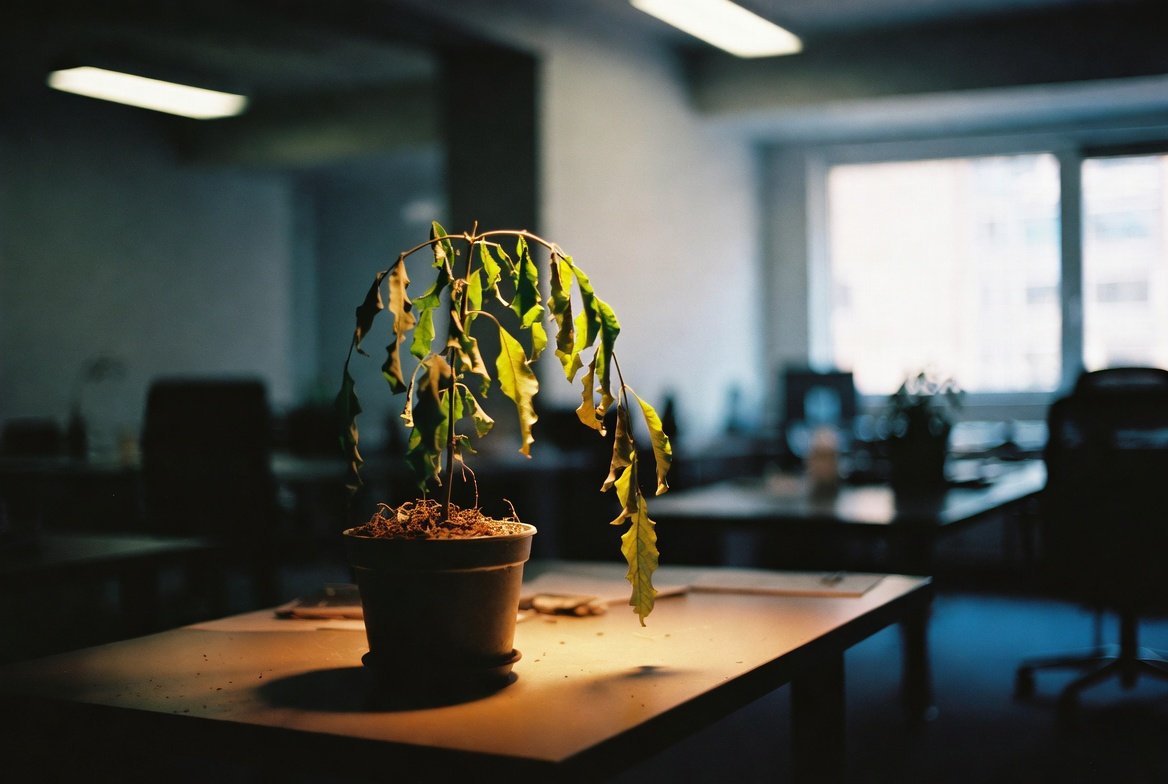
Small homes and workplaces can make live plants harder to keep. Space is limited, natural light can be inconsistent, and air conditioning is common. The usual advice, choose a smaller plant, addresses only the first of those three.
Working with a small space well means being precise about what is actually scarce. In most compact rooms and on most desks, it is not floor area. It is usable surface, and the light that reaches it.
This guide is about working within those constraints: how to audit the space you have, which formats suit which surface, and where the vertical plane changes the arithmetic. The Forever Forest range is organised by surface for the same reason.
The reality of small and indoor spaces
Live plants still need light, water, stable placement and regular attention. A small desk, no balcony, long workdays and dust all make that harder to provide. That does not make live plants a bad choice; it means the room has to support the care they require, and a compact room often cannot.
Two constraints compound in small spaces specifically. The first is that a plant needs a position chosen for its light, and a small space offers fewer positions to choose from, so the good spot is often already occupied by something else. The second is access: watering needs somewhere to put a watering can down, and a drip needs somewhere to go that is not a laptop.
Audit the surface, not the room
Before choosing anything, measure what is genuinely free. On a typical working desk, once a monitor, keyboard, laptop, notebook, phone stand and a mug have taken their positions, the uncommitted area is usually smaller than people estimate, and it is rarely a neat square.
Three questions settle most of it:
- What footprint is actually free, and will stay free? A space that is clear today but used for paperwork twice a week is not free. An object placed there gets moved, and objects that get moved get knocked.
- Is it in the working zone or the edge? Anything within reaching distance of a keyboard will be handled. The back edge, the far corner and the shelf above are where an object can stay put.
- What light does that exact position get? Not the room, the position. A desk two metres inside a room receives considerably less light than one beside the window, and this is the point at which a live plant either becomes viable or does not.
If the honest answer to the third question is “not much”, that is not a reason to give up on greenery. It is a reason to stop looking for a plant that will tolerate the position and choose something for which light is not a survival requirement.
Where preserved botanicals fit
Preserved botanicals are made from real plant material that has been through a preservation process. They need no watering routine and can work in indoor spaces where live plants would be difficult to maintain, provided they are kept dry and away from direct sunlight.
In a small space, three properties matter more than they would elsewhere.
- No access requirement. Nothing has to be reached with a watering can, so a piece can sit at the back of a desk, on a high shelf or on a wall without becoming inconvenient.
- No light requirement. The position can be chosen for where it fits rather than where the light is, which in a compact room dramatically increases the number of viable spots.
- No spill risk. There is no water, no drainage and no saucer, which matters on a surface shared with a laptop and paperwork.
Use the vertical plane
The most under-used space in a small room is the wall. It costs no surface area at all, and in a compact office or apartment it is usually the only genuinely spare plane available.
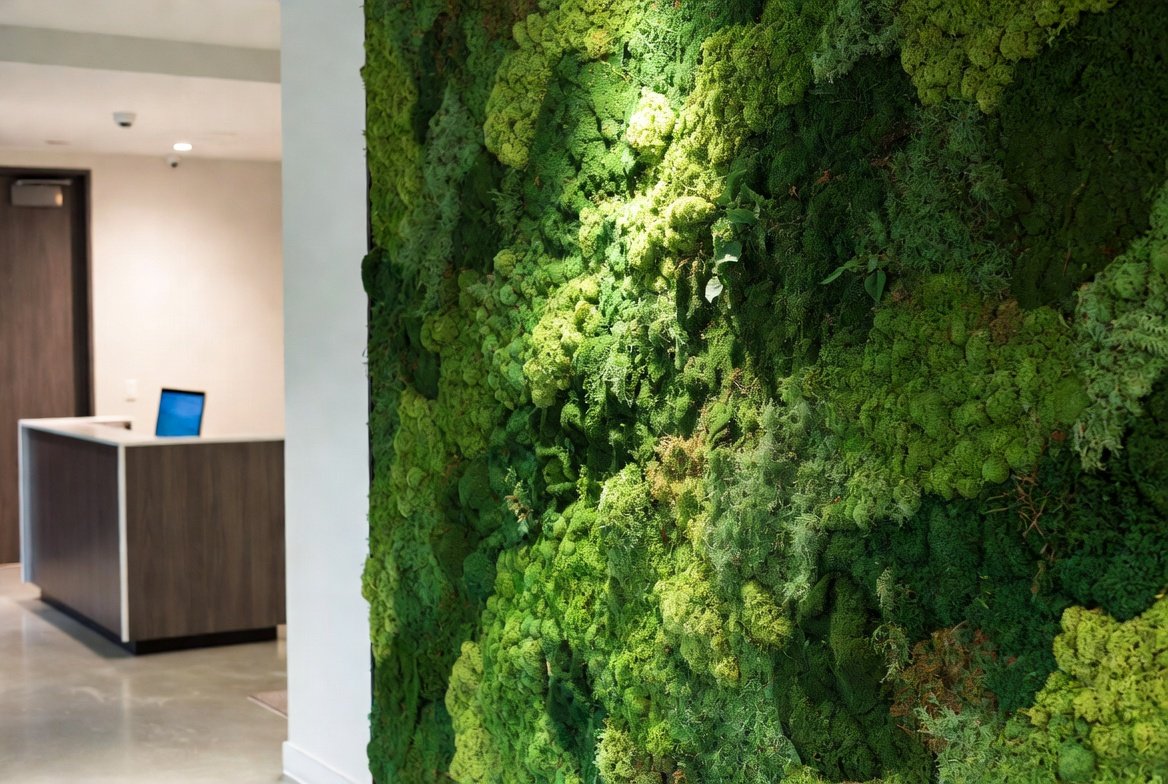
Live green walls are possible and they are an installation: irrigation, drainage, waterproofing and maintenance access. That is a facilities project, not a small-space solution. Framed or mounted preserved moss gives natural texture on the same plane with none of that infrastructure, and it does not consume a single square inch of desk.
The same logic applies to shelves above eye level. A high shelf is a poor position for a live plant, because it is usually dim and awkward to reach, and both of those stop mattering for a preserved piece.
Matching format to surface
Formats in the Forever Forest range are grouped by the surface they are meant for. The sizes below are examples from the range rather than a full list.
| Surface | What suits it | Why |
|---|---|---|
| A working desk | Small desk pieces, around a three-inch footprint | Fits the back edge or corner without competing with the working area |
| A desk with room to spare | Pen stands and combined desk objects | Earns its footprint by doing a second job as well as being a display piece |
| A shelf or side table | Enclosed formats such as domes and terrarium cubes | The enclosure protects the material from dust and handling in a passing-traffic position |
| A wall | Framed and tile formats, up to a 12 x 18 inch lit wall frame | Adds presence without using any surface area at all |
| A cabin or leadership desk | Larger statement pieces, such as a 9 x 15 inch desk format, or 6″ and 8″ award formats | The surface can carry a single deliberate object rather than several small ones |
Shared desks and hot-desking
A surface that is not reliably yours changes the problem. Anything left on a hot desk has to survive being moved by someone else, and anything requiring care has no owner at all: if the desk belongs to whoever booked it that morning, so does the watering, which means nobody does it.
Two approaches work. Either the greenery belongs to the space rather than the person, placed on a wall, a divider or a shared shelf where it is not in anyone's way; or it is small and enclosed enough to be carried, kept and taken home. What does not work is an object that needs a routine but has no permanent custodian.
The work-from-home corner
Home working has produced a lot of desks in positions no one would have chosen for a plant: a corner of a bedroom, a landing, one end of a dining table, a wall away from the window. These positions are usually chosen for where a desk fits, not for light.
This is the case where the honest answer is often the simplest. If the desk is somewhere with good natural light and you enjoy plant care, a live plant is the better object and nothing here competes with it. If the desk is in the corner it had to go in, then greenery that does not depend on light is what will actually still be there.
Choose the position first, then the object. In a compact space the number of genuinely available positions is small, and an object chosen before its position tends to end up somewhere that suits neither of them.
Common small-space mistakes
- Buying to fill a gap. A gap that exists because everything else moves through it is not free space; it is traffic.
- Choosing by footprint alone. Height and handling matter too. A tall narrow object on a busy desk takes little area and gets knocked over regularly.
- Putting greenery on the windowsill by default. For a live plant this is usually the best spot in the room. For a preserved piece it is the worst, because direct sunlight is one of the two conditions to avoid.
- Adding several small pieces instead of one. In a compact space, several small objects read as clutter where a single considered one reads as a decision.
- Ignoring the wall. It is usually the only spare plane in the room and the one people forget to count.
A more realistic approach
Start with the room you have, not the room in the photograph. Establish which positions are genuinely free and what light each one receives, and let that decide the object rather than the other way around.
Where a live-plant routine fits the space and the person, it remains the better choice. Where it does not, preserved botanicals can bring natural texture to a small or low-light space with very little ongoing care, and can go on the wall or the high shelf where a live plant was never going to work anyway.
Questions people ask
Can preserved botanicals work in rooms with very little natural light?
Yes. They do not require light to survive, so they can be placed in areas where live plants would struggle, including interior rooms and desks well away from a window. Keep them indoors, dry and away from direct sunlight.
Are preserved plants suitable for small apartments?
Yes. They do not need a dedicated high-light position or regular maintenance access, which makes them easier to place in compact spaces. In practice this means the position can be chosen for where it fits rather than where the light is.
How much desk space does a small piece actually need?
Compact desk formats in the range start at around a three-inch footprint, which fits a back edge or corner without competing with the working area. The more useful measurement is your own: check what is free, will stay free, and sits outside the zone where things get handled.
What works on a wall when there is no floor or surface to spare?
Framed and tile formats, which range up to a 12 x 18 inch lit wall frame. They use no surface area at all. A live green wall is an alternative but it is an installation with irrigation, drainage and maintenance access, which is a different scale of decision.
Should I put a preserved piece on the windowsill?
No. A windowsill is usually the best position in a room for a live plant and the worst for a preserved piece, because direct sunlight is one of the two conditions that damage the material. Choose an interior surface, a shelf or a wall away from direct sun instead.
What suits a hot desk or shared surface?
Either something that belongs to the space rather than a person, placed on a wall, divider or shared shelf, or something small and enclosed enough to be carried and kept. An object that needs a routine but has no permanent custodian is the arrangement that reliably fails.
Do enclosed formats suit small spaces better than open ones?
Often, yes, in busy positions. The enclosure protects the material from dust and handling, which matters most on a shelf or shared table where things pass close by. Enclosed pieces also carry a longer display expectation: 5 or more years, against 3 or more for open pieces, under recommended indoor conditions.
Will a preserved piece be damaged by air conditioning?
Dry indoor air is not a problem for preserved material, and in that respect it is easier to place than a live plant, which generally finds persistently low humidity harder than its label suggests. Damp is the condition to avoid, along with direct sunlight.
Is one larger piece better than several small ones?
In a compact space, usually yes. Several small objects on a limited surface tend to read as clutter, while a single considered piece reads as a decision. It also concentrates the display value in one position that can be properly chosen rather than spreading it across several that cannot.
Bring nature into even the smallest spaces.
Explore compact desk pieces, framed preserved-nature displays and gifting formats designed for real indoor conditions.
