

Plant labels often promise “low maintenance”, “beginner friendly” or “hard to kill”. They are useful shortcuts, and they are also the reason a lot of people conclude they are bad with plants when the label was simply describing something narrower than they read into it.
Low maintenance is a relative term. It says a plant needs less frequent attention than some other plant. It does not say the plant needs very little, and it says almost nothing about the condition that most often decides the outcome indoors.
This article unpacks what the label is actually claiming, which variable it leaves out, and how to read it usefully. For the comparison between live plants, artificial greenery and preserved botanicals, see that guide; this one stays with the label itself.
What the label is actually claiming
“Low maintenance” is a comparison, and the thing being compared is almost always watering frequency. A plant that tolerates a fortnight between waterings is genuinely less demanding than one that wants attention twice a week. That is a real and useful difference.
What the phrase does not cover is everything else a plant depends on. Light. A stable position. Air that is not permanently dried out. Somewhere the pot can drain. The label compresses all of that into a claim about one variable, and readers reasonably assume the claim covers the rest.
It is worth saying that this is not usually dishonest. A grower comparing two plants on watering frequency is telling the truth about watering frequency. The gap opens between what is being measured and what a buyer needs to know.
The variable the label leaves out
Indoors, light is the constraint that most often decides whether a plant does well, and it is the one people are worst at judging. Human eyes adapt to a very wide range of brightness, so a room that feels perfectly well lit can be delivering a small fraction of what a plant near a window would receive.
Two things make this worse in offices and apartments. Light falls away sharply with distance from a window, far faster than it appears to, so a desk a few metres inside a room is in a genuinely different condition from one beside the glass. And artificial office lighting, however bright it looks, is generally designed around what people need to read by rather than what a plant needs to grow.
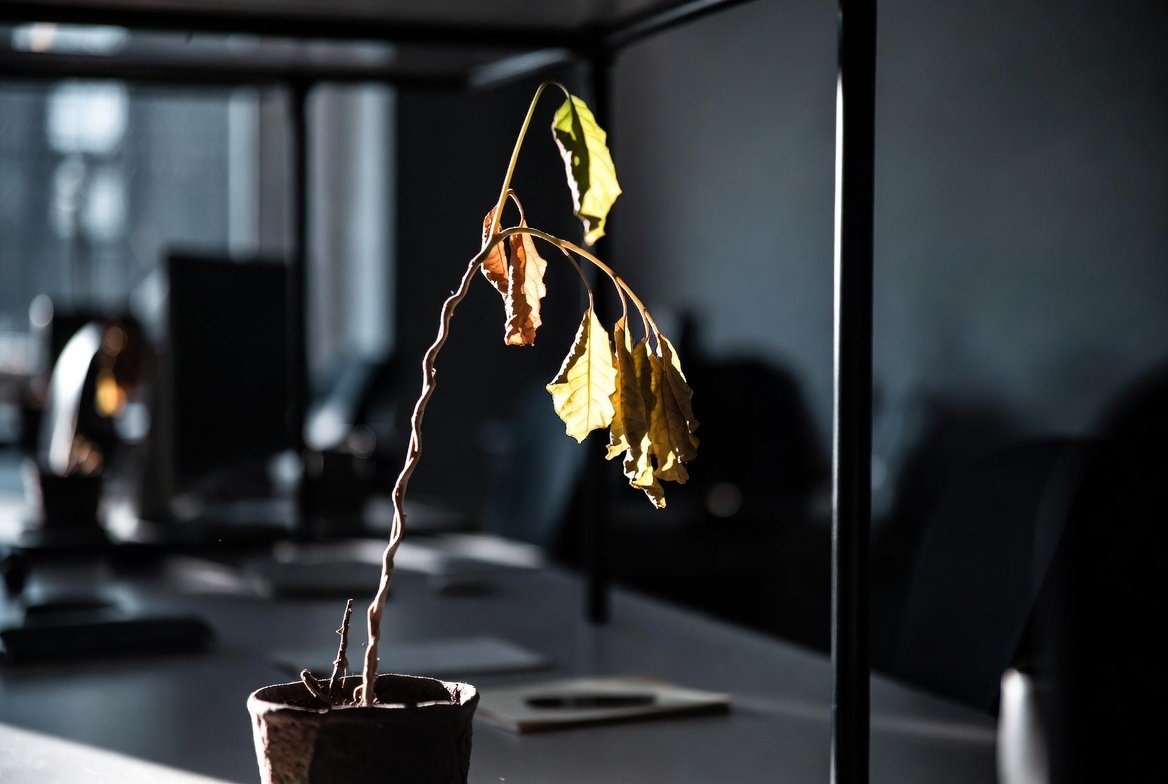
The result is a slow, quiet failure. Under-lighting rarely produces a dramatic event. The plant simply gets gradually thinner, paler and more stretched over months, and by the time it looks obviously wrong, the position that caused it has felt normal for so long that nobody connects the two.
The four conditions behind the phrase
A more honest version of “low maintenance” would name all four of the things a plant is actually asking for.
- Light. Enough of it, for enough of the day, in the position the plant will actually occupy rather than the position it was bought in.
- A watering rhythm. Regular without being excessive. This is a judgement about the plant and the season, not a fixed calendar entry, which is why it resists being automated.
- A stable position. Plants adjust slowly to their conditions. Moving one between desks, or between a bright week and a shaded corner, resets that adjustment each time.
- Tolerable air. Air conditioning holds temperature steady and keeps humidity low. Steady temperature is not a problem; permanently dry air is a condition many indoor plants find harder than their labels imply.
“Low maintenance” addresses the second of these and stays quiet about the other three.
What “hard to kill” actually means
The resilient houseplants people are usually pointed towards are genuinely more forgiving than most. But it is worth being precise about what that forgiveness is.
These plants generally tolerate low light rather than prefer it. Tolerance is a real property and it is not the same as indifference: a tolerant plant in a dim position declines more slowly than an intolerant one would, which buys months rather than solving the problem. The plant is not thriving. It is holding on for longer while it runs down its reserves.
Similarly, plants described as drought-tolerant are usually storing water in thick leaves, stems or roots. That storage is what lets them skip a watering, and it is also what makes them vulnerable to the opposite error: consistently wet soil is a far more common cause of death in these plants than a missed watering ever is. The forgiving plant and the plant you can water generously are not the same plant.
The hidden costs of keeping live plants
Before choosing a live plant, it is worth accounting for the practical costs alongside the purchase price.
- Time and attention for checking, watering and occasional care. Small individually, recurring indefinitely.
- Replacement cost if the plant does not survive and has to be bought again, which for a corporate programme is a budget line that usually does not exist.
- Placement constraints: finding a spot with the right light, that is not in the way, and that someone can reach to look after.
- Ownership: deciding who is responsible, including during leave and travel. On shared surfaces this is the cost that quietly goes unpaid.
- Visible failure: a declining plant is a conspicuous object. It sits at eye level on a desk and is noticed daily, which is why an unsuccessful plant gift lingers in a way an unremarkable one does not.
Ask what light the position actually gets, who is responsible for it during a two-week absence, and what happens if the answer to either is unsatisfactory. A plant that survives those three questions will do well. One that does not will struggle regardless of what the label says.
Reading the label usefully
None of this makes “low maintenance” a useless phrase. It makes it a comparative one, best read as a ranking rather than a promise.
Used that way it works. Between two plants for the same position, the lower-maintenance one is the better bet. What it cannot do is tell you whether the position itself is viable, and that is the question that decides most indoor outcomes. Ranking is helpful; it is just not the same as a verdict on your room.
A more honest approach
Start with the time and the conditions you actually have, then choose the object that fits them, rather than choosing the object and hoping the conditions arrive.
Where there is light and someone who wants to look after a plant, a live plant is the right answer and a forgiving variety makes it easier. Where the light is poor, the surface is shared, or the object has to survive without an owner, the honest move is to stop looking for a plant that needs less and choose something that needs nothing.
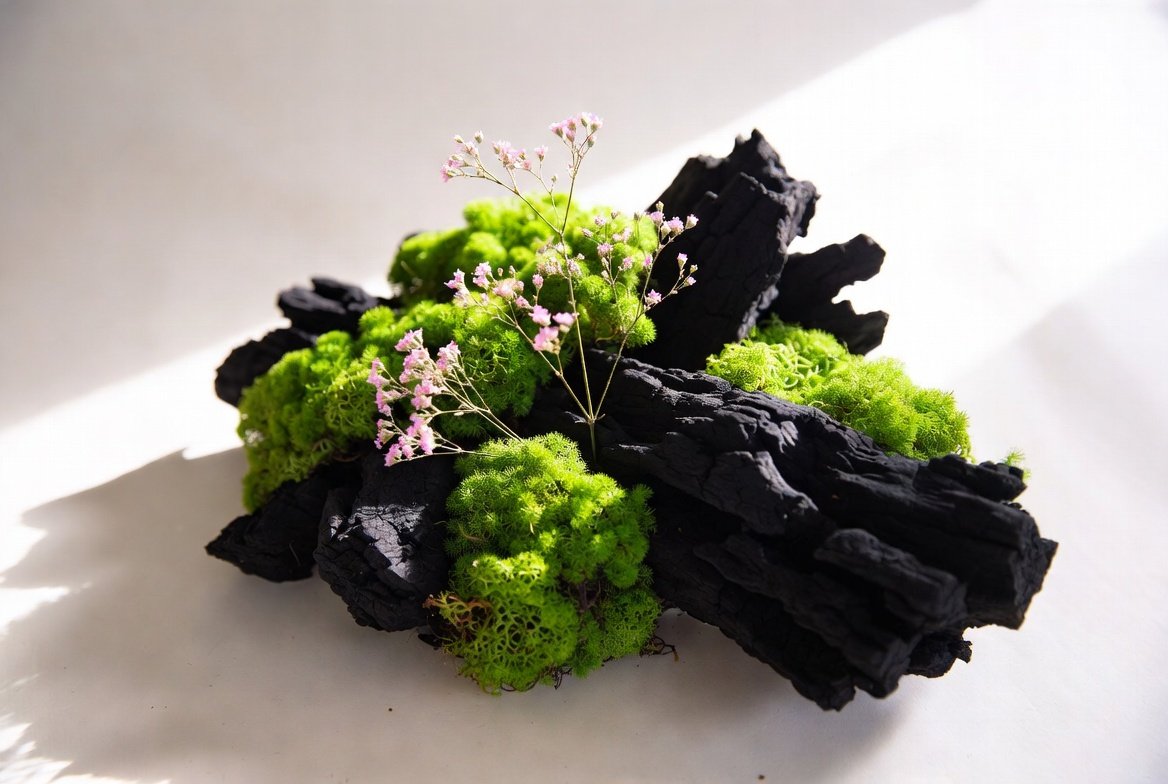
Preserved botanicals are one such option: real plant material that has been through a preservation process, needing no watering routine, and able to remain on display for years under recommended indoor conditions. They are not a better plant. They are a different kind of object, and the difference is that the outcome no longer depends on a routine surviving contact with a normal week.
Questions people ask
Are there any plants that are truly zero maintenance?
No. Live plants need at least some care and suitable conditions to stay healthy indoors. The most forgiving varieties reduce how often attention is needed; none of them remove the need for adequate light and an occasional check.
Why do “low maintenance” plants still die?
Because even low-maintenance plants depend on suitable light, occasional care and steady conditions. The label describes watering frequency relative to other plants; it does not address whether the position has enough light, which is the factor that most often decides the outcome indoors.
Is light or water the bigger problem indoors?
Usually light. Watering errors are visible and correctable; under-lighting is invisible and cumulative. A plant several metres from the nearest window is in a genuinely low-light position even when the room feels bright, because human vision adapts across a far wider range than plants can use.
Does “tolerates low light” mean the plant will do well there?
No. Tolerance means it declines more slowly than a less tolerant plant would. It buys time rather than solving the problem, and a plant held in a dim position for long enough will still thin out and stretch as it uses up its reserves.
Can office lighting substitute for daylight?
Generally not at the intensity most indoor plants want. Office lighting is designed around what people need in order to read comfortably, which is a much lower requirement than growth. Purpose-built grow lighting is a different proposition, but it is a deliberate installation rather than something a room happens to have.
Does air conditioning harm indoor plants?
The steady temperature is not usually the issue; the persistently low humidity is what many indoor plants find harder than their labels suggest. It is a background condition rather than a sudden problem, which is why it tends to be overlooked when a plant does not do well.
Is over-watering really more dangerous than under-watering?
For the resilient varieties usually recommended as low maintenance, yes. Those plants store water in thick leaves, stems or roots, and that storage is exactly what makes consistently wet soil a problem for them. The property that lets them survive a missed watering is the same one that makes generous watering a risk.
Do preserved botanicals need any maintenance at all?
Very little, and none of it is a routine. Keep them indoors, dry and out of direct sunlight, and dust them gently when needed. There is no watering, misting or feeding, and cleaning should not involve moisture, since water is the condition the material is protected from.
How long do preserved pieces stay presentable?
Under recommended indoor conditions, open pieces can remain on display for 3 or more years and enclosed pieces for 5 or more. These are expectations under suitable conditions rather than guarantees. Placement does most of the work: damp and direct sun are the two things that shorten it.
Looking for greenery without the hidden costs?
Explore preserved-nature pieces designed for desks, shelves and gifting contexts where live plants would be harder to sustain.
