

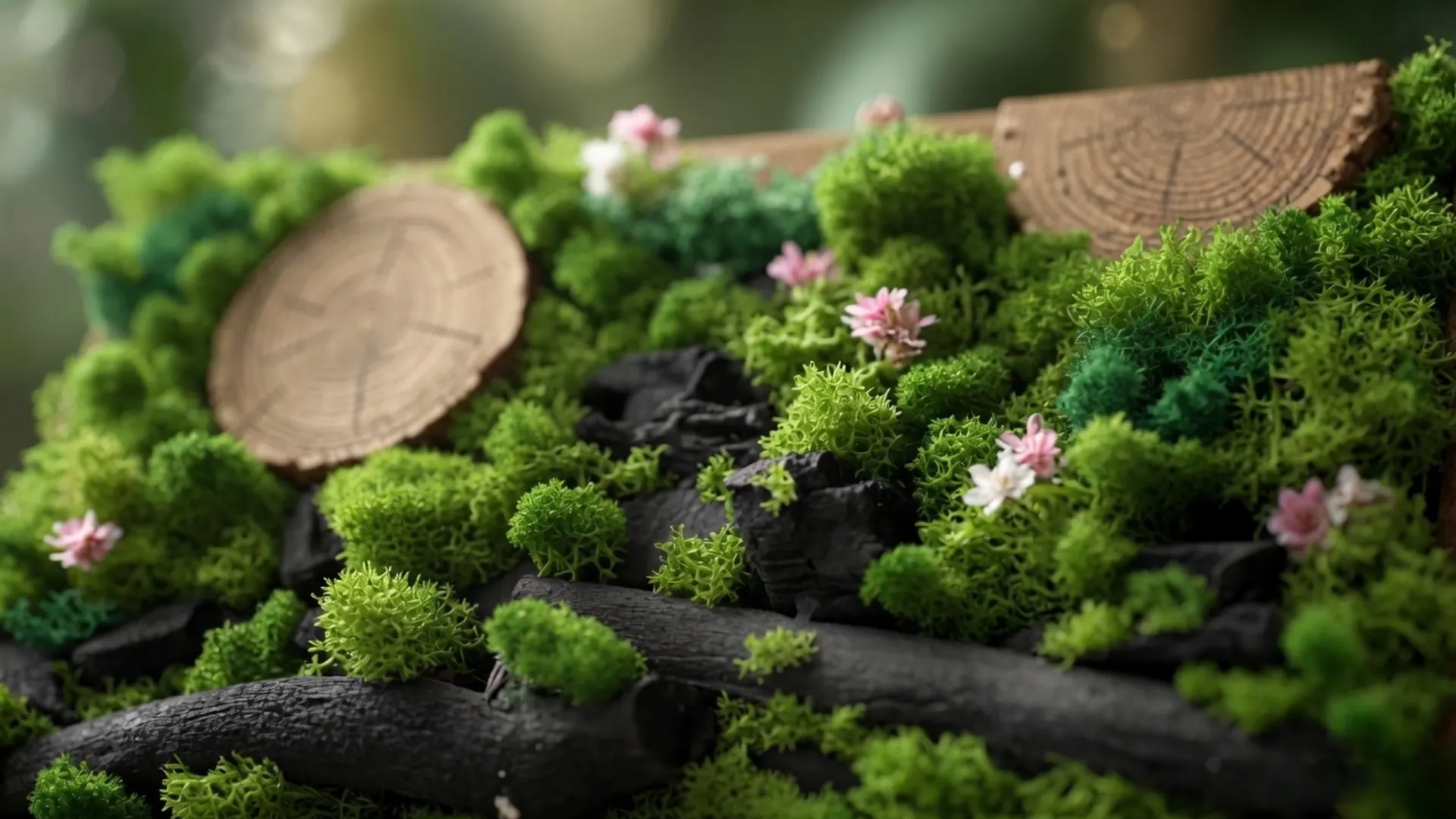
When people want to bring greenery indoors, they usually consider three options: live plants, artificial plants, or preserved botanicals. Each one solves a slightly different problem, and each one asks for something different in return.
Most comparisons stop at appearance and price. Those matter, but they are rarely what decides whether a piece of greenery is still there a year later. What decides that is the match between the object and the room it lands in, and the honesty of the care routine attached to it.
This guide compares the three on the terms that actually change the outcome: what each one is made of, what it asks of the person who receives it, how it fails when it fails, and what changes when you are buying for one desk rather than two hundred. The Forever Forest range covers the preserved side in product detail; this article is about choosing between the three in the first place.
The quick comparison
Read this as a starting frame rather than a verdict. The rows below are the factual differences; the sections after it explain when each difference actually matters.
| Factor | Live plants | Artificial plants | Preserved botanicals |
|---|---|---|---|
| Real plant material | Yes | No | Yes |
| Maintenance required | High | None | Very low |
| Natural look and feel | Excellent | Average | Very good |
| Lifespan | Months to 3 years | 3–6 years | 3+ years open 5+ years enclosed |
| Works in low light | Limited | Yes | Yes |
| Produces oxygen | Yes | No | No |
| Main failure mode | Dies from missed care or poor light | Looks synthetic on close inspection | Damaged by damp or direct sun |
| Who has to do something | The recipient, repeatedly | Nobody | Nobody, beyond placement |
What each option actually is
The three categories are often described as if they sat on a single scale from natural to fake. They do not. They are three different kinds of object.
Live plants
A living organism that grows, responds to its environment and depends on light, water and air. It changes over time. That change is the appeal for people who enjoy it, and the burden for people who do not have the conditions to support it.
Artificial plants
A manufactured object, typically plastic or fabric, shaped to resemble a plant. It contains no plant material. Its appearance is fixed from the day it is made, which is both its reliability and its limit.
Preserved botanicals
Real moss and botanical material that has been through a preservation process. Under controlled conditions, a bio-based preservation blend gradually replaces the plant's natural moisture, and the material is then selected and arranged by hand. It is real plant material, and it is no longer living. It does not grow, and it does not need water.
Live plants: rewarding, and genuinely demanding
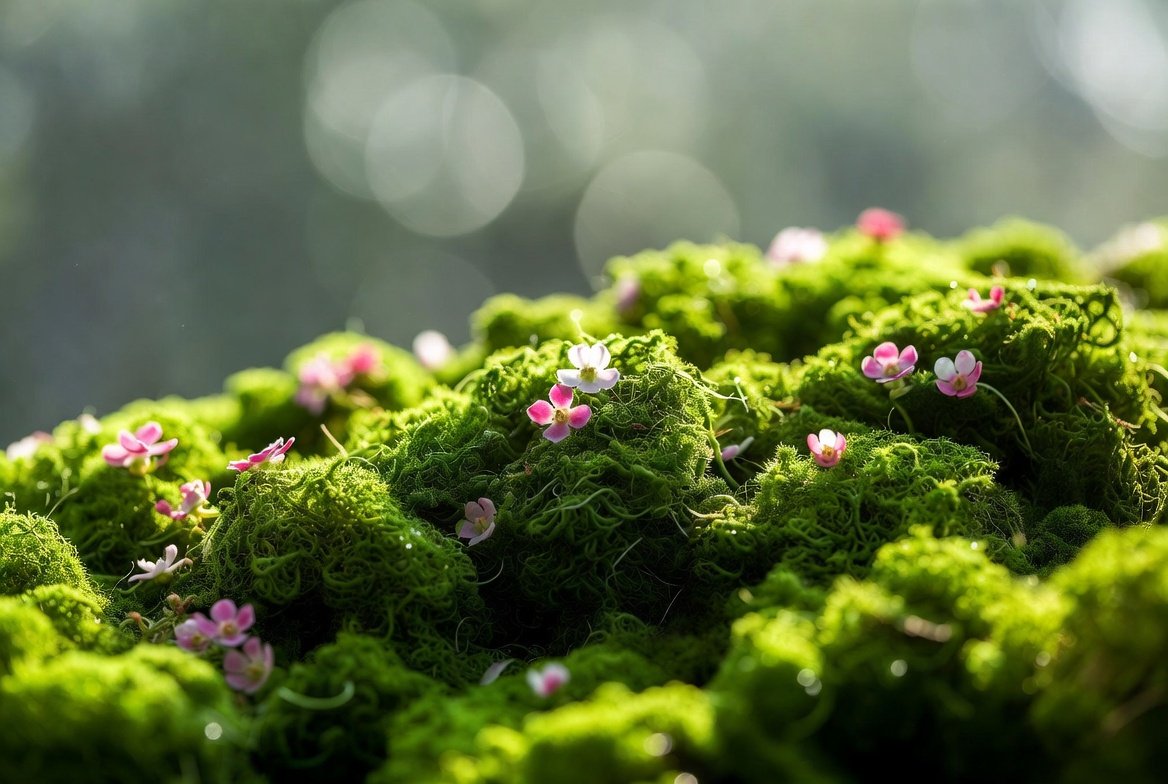
Live plants grow and respond to their surroundings, and many people enjoy caring for them. Where that care is part of the pleasure, and the conditions support it, nothing else in this comparison replaces them.
The conditions are the harder half. Air conditioning dries the air and holds temperature steady in a way most indoor plants did not evolve for. Natural light indoors is often weaker and more directional than it looks to the eye. Watering has to be regular without being excessive, which is a judgement, not a schedule. Add travel, long working days, dust and a change of desk, and the routine breaks in ordinary ways.
It is worth being clear about what fails first. In practice, light is the usual constraint rather than water. A plant placed several metres from the nearest window in an artificially lit office is under-lit whether or not anyone waters it correctly. This is covered in more depth in what the low-maintenance label leaves out.
Artificial plants: convenient, and visibly so
Artificial plants remove the watering routine and the light requirement completely. Where zero plant care is the only acceptable answer, and the object simply has to read as green from a distance, they do that job.
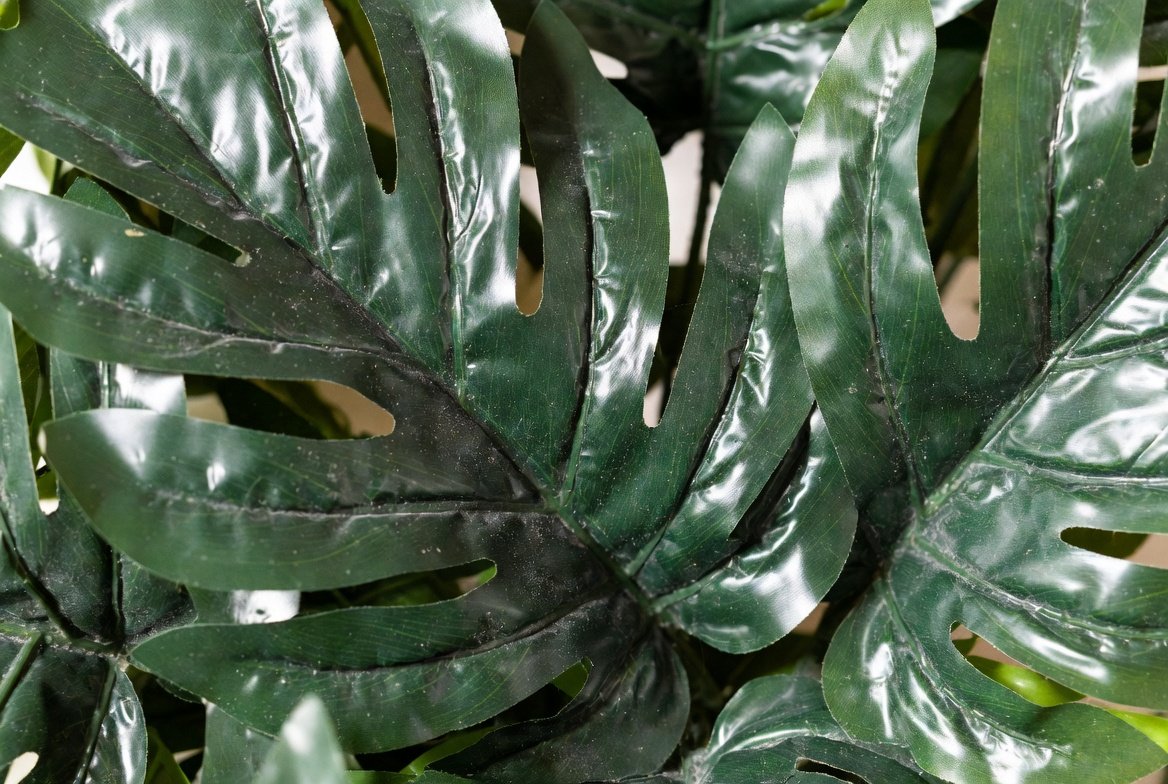
Two things limit them. The first is close inspection: moulded leaves and uniform colour tend to give themselves away at desk distance, which is exactly the distance at which a desk object is seen. The second is dust. An artificial plant collects it and, unlike a living leaf, has no way of shedding it, so the piece tends to look progressively duller unless someone cleans it.
For some buyers that matters less than the convenience. For others it is the deciding drawback, particularly when the object is a gift and the recipient will read it as a statement about the giver.
Where preserved botanicals sit
Preserved botanicals are not a replacement for every use. Their place is between live-plant care and artificial greenery: real botanical material, without a watering routine.
- Real plant material. Made from actual moss and botanicals, they retain natural colour, texture and softness under recommended indoor conditions.
- No watering routine. Keep them indoors, dry and away from direct sunlight. No watering or misting is needed.
- Flexible placement. They can be used on walls, in low-light areas, on desktops and in small decorative objects, because light is not a survival requirement.
- Predictable over time. The piece you hand over is close to the piece that will still be there in a year, which is a useful property when you are not in the room to check.
They have real limits, and they should be stated. They do not produce oxygen, because the preservation process stops biological activity. They do not grow, so nobody gets the satisfaction of watching them change. And they are damaged by the two conditions their care instructions name: damp, and direct sunlight.
The three-year view
A comparison made on the day of purchase flatters whichever option is cheapest. A more useful question is what each choice asks for over the following three years, because that is the period across which the differences actually show up.
| Over three years | Live plants | Artificial plants | Preserved botanicals |
|---|---|---|---|
| Ongoing effort | Watering, light management, occasional repotting | Occasional cleaning | Gentle dusting; keep dry and out of direct sun |
| Likely intervention | Replacement if conditions do not suit it | Replacement when it looks tired | None expected within the display period |
| If nobody does anything | It declines and usually dies | It dulls with dust | It stays as it is, if the placement was right |
| Cost of being wrong | The plant, and the reminder of it | A piece that reads as filler | A piece placed in damp or direct sun |
Note where the risk sits in each column. With a live plant, the risk is spread across three years of small decisions by whoever ends up responsible. With a preserved piece, almost all of the risk is concentrated in a single decision at the start: where it is put. That is a meaningfully easier thing to get right, particularly when the object is a gift and you will not be there to correct the placement.
Decide by room, not by preference
The most common mistake is choosing the option you like best and then hoping the room cooperates. Start from the room instead.
A desk with no nearby window
Live plants are working against the main constraint here, because artificial light rarely substitutes for daylight at the intensity most indoor plants want. A small preserved piece or a well-made artificial one is the realistic choice, and at desk distance the material difference between the two is visible.
A reception or shared table
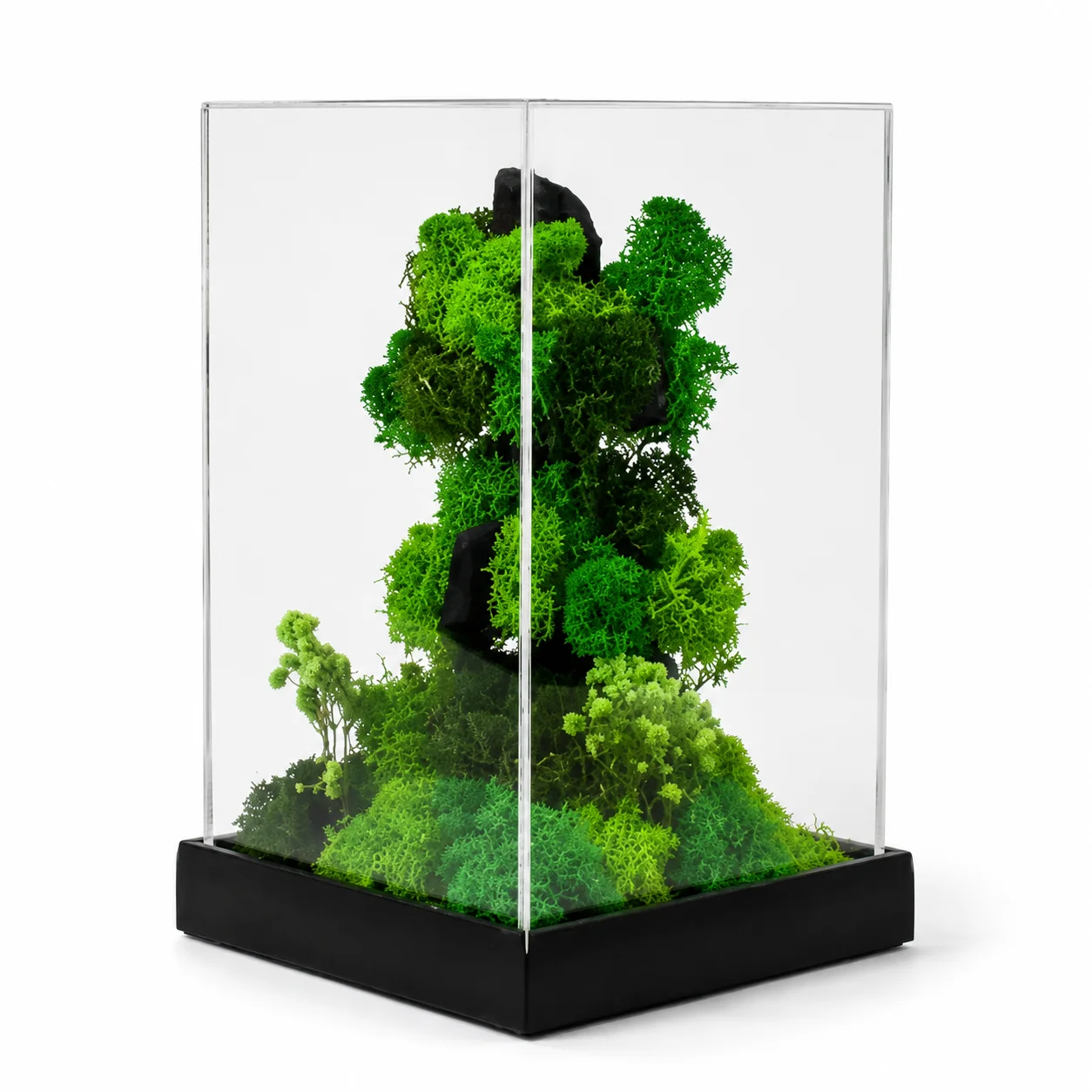
Nobody owns a shared surface, which means nobody owns the watering. Shared surfaces also see more handling and more dust. An enclosed preserved format suits this well, because it protects the material and does not depend on somebody taking responsibility.
A wall
Live green walls are possible and they are a facilities commitment, with irrigation, drainage and maintenance access. Framed or mounted preserved moss gives natural texture on a wall without any of that infrastructure. See bringing nature into small spaces for how wall formats free up surface area.
A home corner with good light and an interested owner
This is the case where a live plant is the better answer. There is light, there is someone who wants to do it, and the growth is the point. Preserved pieces are not competing for this spot, and it is more useful to say so than to pretend otherwise.
One desk versus two hundred
Everything above changes scale when the decision is a corporate one. Buying greenery for a team is a different problem from buying it for yourself, and it is the part most comparisons leave out.
Three things shift. Consistency becomes a requirement: a hundred live plants will diverge within months, because a hundred desks have a hundred different light conditions and a hundred different owners. Follow-through disappears: there is usually no plan for who waters a gifted plant when the recipient is on leave, and no budget line for replacing the ones that do not make it. And the failure is visible: a dying plant on a desk is a more pointed reminder of a gifting decision than an empty desk would have been.
This is the practical reason preserved formats appear in corporate gifting more often than live plants do. It is not that they are better objects in the abstract. It is that they survive being handed to two hundred people whose desks, habits and interest levels you cannot see. If you are working through that decision for a specific programme, the Forever Forest range is organised by surface: desk, shelf, wall and recognition.
None of the three is the correct answer on its own. Live plants win where there is light and a willing owner. Artificial greenery wins where cost and indifference to material are the constraints. Preserved botanicals win where you want real plant material to still be there, unchanged, without anyone having agreed to look after it.
A practical middle path
Preserved botanicals are not meant to completely replace live plants. Many people still prefer live greenery when they have suitable conditions and enjoy caring for it, and that preference is worth respecting rather than arguing with.
What preserved pieces offer is real plant material that can stay on display under recommended indoor conditions without daily attention. That suits busy professionals, compact homes, and corporate spaces where a live-plant routine is unlikely to last beyond the first month. Choosing one is less a statement about caring less, and more an accurate reading of the room.
Questions people ask
Do preserved plants produce oxygen?
No. The preservation process stops biological activity, so preserved botanicals do not perform photosynthesis or release oxygen. If oxygen production or air quality is the objective, a live plant in suitable conditions is the option that addresses it.
How long do preserved botanicals last?
Under recommended indoor conditions, open pieces can remain on display for 3 or more years, and enclosed pieces for 5 or more years. Keep them indoors, dry and away from direct sunlight. These are display expectations under suitable conditions rather than a guarantee, and placement is the largest single factor.
Are preserved botanicals the same as dried flowers?
No. Drying removes moisture and leaves the material brittle and faded. In preservation, a bio-based blend gradually replaces the plant's natural moisture under controlled conditions, which is why preserved material keeps more of its colour, softness and texture than dried material does.
Can preserved botanicals work in low-light areas?
Yes. They do not need light to survive, so they work in spaces where live plants usually struggle, including interior rooms and desks far from a window. Direct sunlight is the condition to avoid, not the absence of light.
Will the colour fade over time?
Colour holds well under recommended indoor conditions. Direct sunlight is the main risk, which is why the care guidance names it specifically. A piece placed on a sunlit windowsill is in the one position the material is least suited to, regardless of how good the placement looks.
How do you clean a preserved piece?
Dust gently, with a soft brush or a light stream of air. Do not wash, wipe with a damp cloth or mist it. Water is the thing the material is protected from, so cleaning methods that involve moisture work against the piece rather than for it. Enclosed formats need less of this than open ones.
Are preserved botanicals suitable around children and pets?
They are display objects and should not be ingested. Enclosed formats put a physical barrier between the material and curious hands, which is usually the more practical answer in a home with small children. Ask us about a specific product or placement if this matters in your setting.
Which option makes sense for an office of two hundred desks?
Preserved pieces, in most cases, because they behave the same on every desk regardless of light and regardless of whether anyone takes responsibility for them. Live plants at that scale need a maintenance plan, a replacement budget and someone who owns both. If those exist, live plants remain viable; if they do not, the programme tends to look worse after three months than it did on day one.
Can live plants and preserved pieces be used in the same space?
Yes, and it is often the most sensible arrangement. Put live plants where the light and the willingness exist, and use preserved pieces for the interior desks, shared surfaces and walls where a care routine would not survive. The two are solving different parts of the same problem.
Ready to bring real preserved nature into your space?
Explore desk pieces, wall art and custom corporate gifts from the Forever Forest range.
