
Of India's inland waters carry water hyacinth, by published estimates.
Jalkumbhi by bioQ · 2027 edition
Paper from India's most invasive water plant.
Seed paper adds a plant. Jute is farmed. Water hyacinth is removed — and a B6 Jalkumbhi calendar takes 3 kg of it out of an Indian waterway before a single sheet is printed.
100% water hyacinth. No fibre blend. No certification claims. One number, calculated in the open.
100%Water hyacinth. No cotton rag, no waste-paper blend.
40 : 1Kilos harvested from the water per kilo of finished paper.
3 kgCleared from Indian waterways per B6 calendar. 6 kg for B5.
0Hectares farmed. Nothing was grown, irrigated or sown to make this.
The problem, first
It doubles its mass every fortnight.
Water hyacinth was brought to India as an ornamental during colonial rule — a pretty lilac flower for garden ponds. It escaped. Bengal named it the terror of Bengal, and the name travelled with the plant.
A floating mat blocks sunlight from everything beneath it. Oxygen drops. Fish die. Irrigation canals, drinking-water intakes and boat routes silt up and stop working. Municipalities clear it, at cost, and it grows back inside a season.
It is not a shortage problem. It is a surplus problem — and surplus is the one thing a paper mill can use.
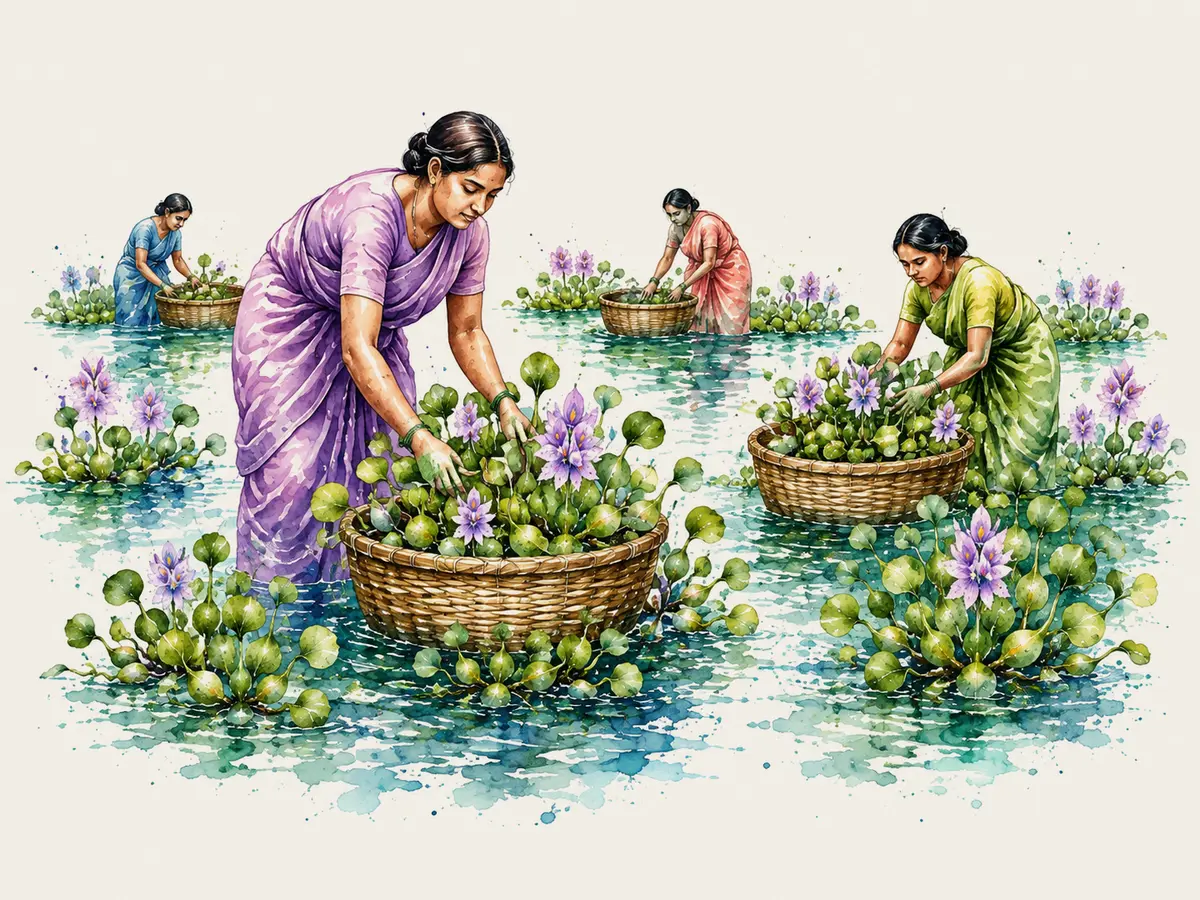
The tentative cost quoted to clear water hyacinth from 53 lakes in Hyderabad alone.
Reported doubling time under favourable conditions. We quote the conservative end.
A bloom lasts barely a day, then folds and pulls its seed head under the surface.
The turn
The thing that makes it a menace is the thing that makes it useful.
Water hyacinth floats because its stalks are packed with air chambers. That buoyancy is exactly why a single plant can take a lake in a fortnight — it never has to root, never has to compete for soil, and drifts wherever the water goes.
Those same stalks are long-fibred and low in lignin. Low lignin means the fibre releases with a gentler, less chemical cook than wood pulp needs, and the sheet does not need bleaching to sit at its natural flecked oatmeal.
Nothing about this plant was designed for us. We are simply using what the problem is made of.
A weed becomes a raw material the moment somebody is willing to pay for it by weight.
Three eco calendars, three different claims
Adds. Farms. Removes.
Every sustainable calendar makes a claim about material. Very few state which direction that claim runs. Here is ours, next to the two you will be comparing it against.
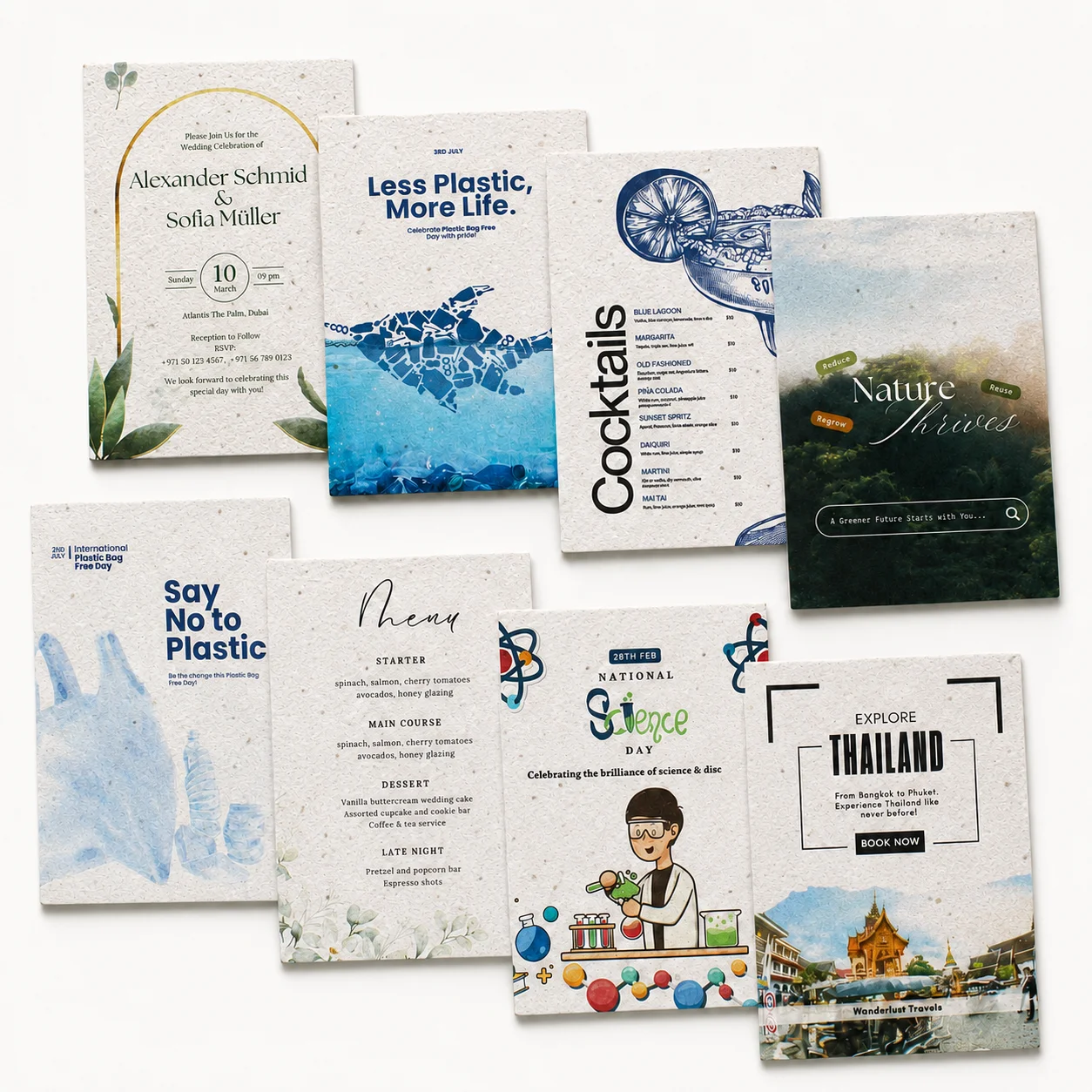
Seed paper — it adds
A plant, after use
Handmade paper with seeds embedded. The recipient plants it and something grows, under the right conditions. A genuinely good product — bioQ has led this category in India for years.
But nothing was taken out of anywhere to make it.
Jute and wood — they farm
A crop, grown to order
Jute is a renewable, biodegradable and well-established fibre. It is also a farmed crop: it takes land, water, a season and a harvest cycle, and it competes with food on that land.
Renewable is not the same as surplus.
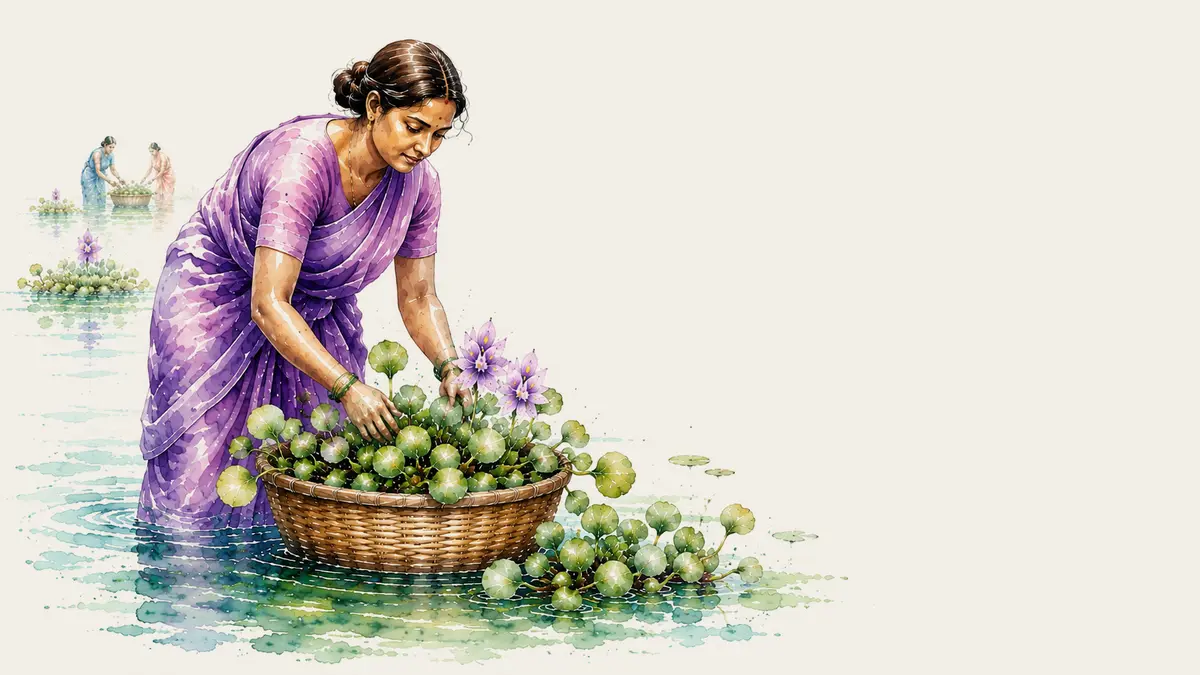
Water hyacinth — it removes
A problem, subtracted
No land. No seed. No irrigation. No season. The raw material is already there, already unwanted, and already being cleared at public cost. We buy it by weight.
Every kilo bought is a kilo pulled out of an Indian waterway.
All three beat a laminated wall calendar. Only one of them is made of a problem.
Compare every eco calendar material, including cork and wood →
The arithmetic, shown
40 kilos out of the water. One kilo of paper.
Most impact numbers in this industry are derived, rounded up and never explained. Here is the whole chain, including the losses, so you can check it.
-
Step 01 · Harvest40 kg
Freshly pulled water hyacinth, wet. Roughly 90–95% of that weight is water.
-
Step 02 · Sun-dry2–4 kg
Days in the open collapse the plant to 5–10% of its harvest weight.
-
Step 03 · Pulp0.8–1.4 kg
Only stalks carry usable fibre. Pulping yield from dry mass runs 30–40%.
-
Step 04 · Sheet1 kg
Finished, printable handmade paper at roughly 245 gsm.
Why we publish 40:1 and not a bigger number.
Compounding those two losses gives a defensible band of 25:1 to 67:1. We publish 40:1 — mid-band, deliberately not the flattering end. Because the sheet is 100% water hyacinth with no blend, there are no fibre fractions to argue over.
And we are careful about what the number describes. We claim what left the water, not what is in the sheet:
- ✓“3 kg of water hyacinth was cleared from Indian waterways to make this calendar.”
- ✕“Contains 3 kg of water hyacinth.” It holds 75 g of fibre. Clearing that 75 g took 3 kg out of the water.
- ✕“Saves X trees.” “Carbon neutral.” “Certified sustainable.” We make none of these claims.
From waterway to sheet
Four stages. All of them by hand.
No machinery beyond a beater, no bleaching, and no step that needs the plant to have been grown on purpose.
Clears our waterways
Taken from canals, lakes and irrigation channels where it is already being removed at public cost.
Harvested by hand
Pulled from the water and sorted on the bank. Roots and flowers are discarded — only the stalks carry fibre.
Sun-dried naturally
Days in the open air. A barrow of green weed becomes a handful — this is where 90–95% of the weight goes.
Crafted into paper
Cooked, beaten to pulp, lifted one sheet at a time from the vat, then pressed, dried and printed.
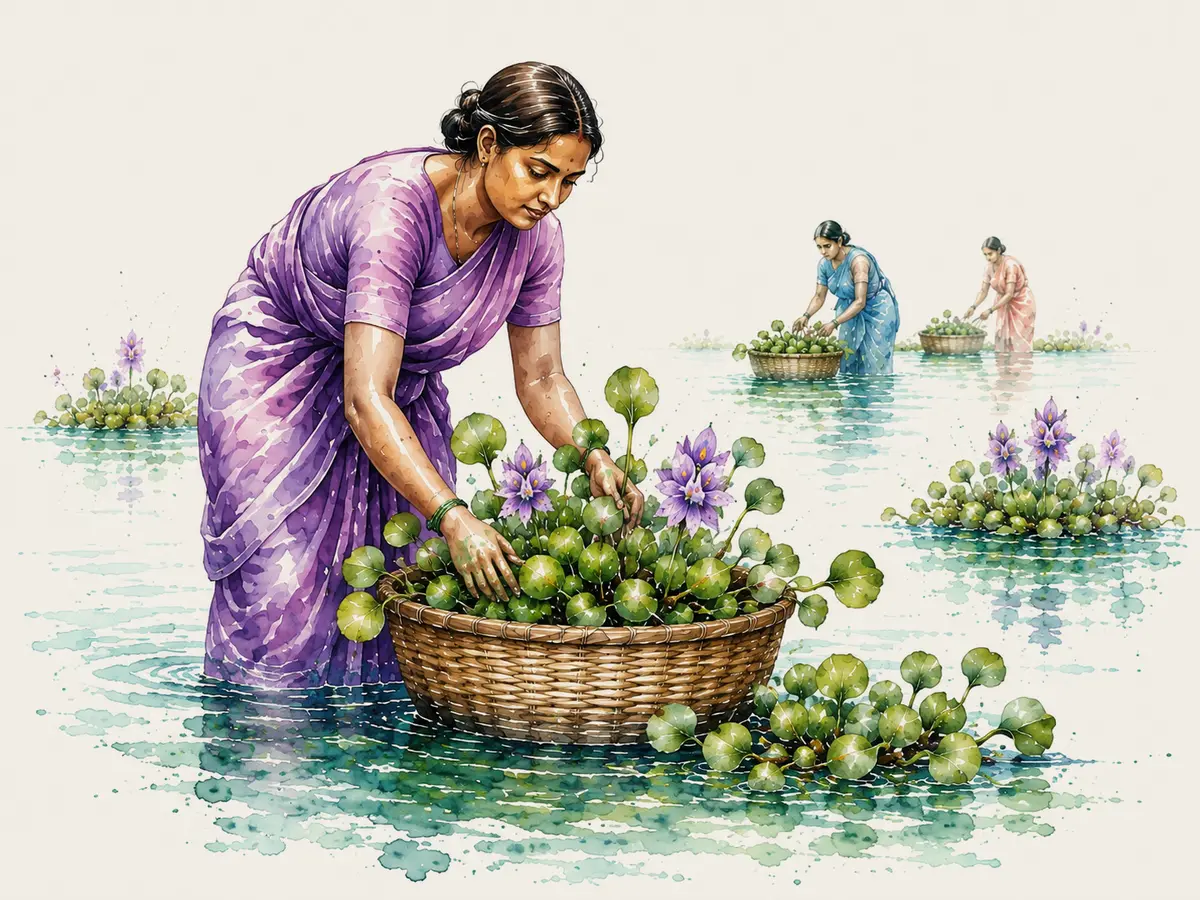
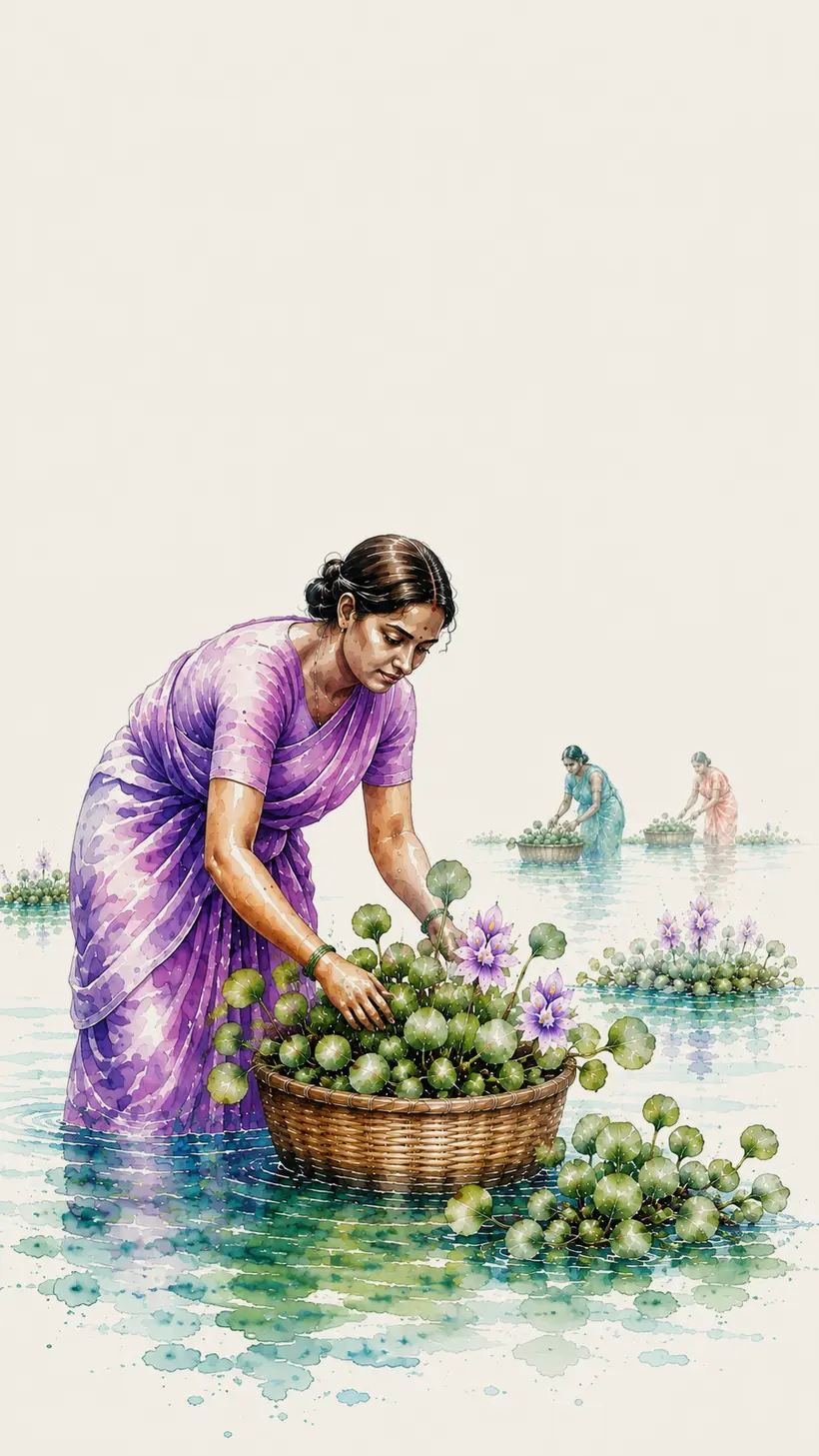
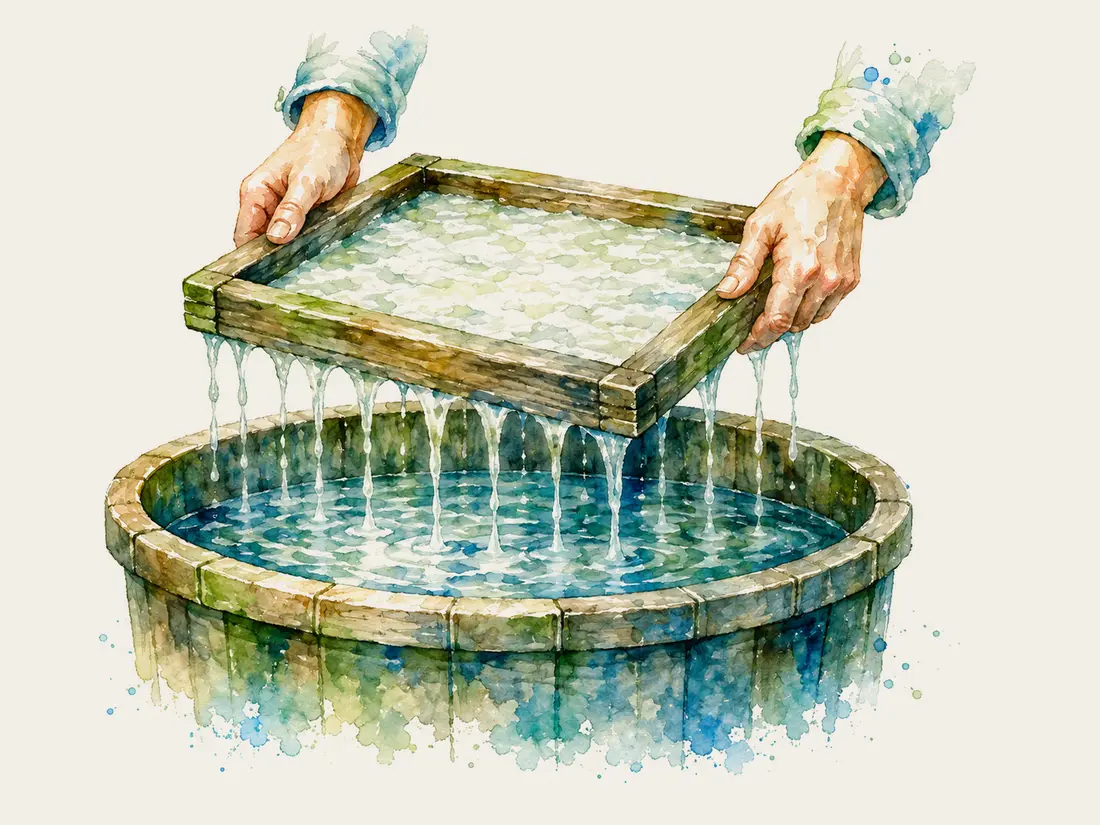
- HarvestedPulled from the water by hand.
- StrippedRoots and flowers discarded.
- Sun-driedDays in the open air.
- CookedSoftened until the fibre releases.
- BeatenPulped to an even slurry.
- LiftedFormed sheet by sheet from the vat.
- PressedDried, finished, printed.
The artwork
Twelve months spent looking closely at one plant.
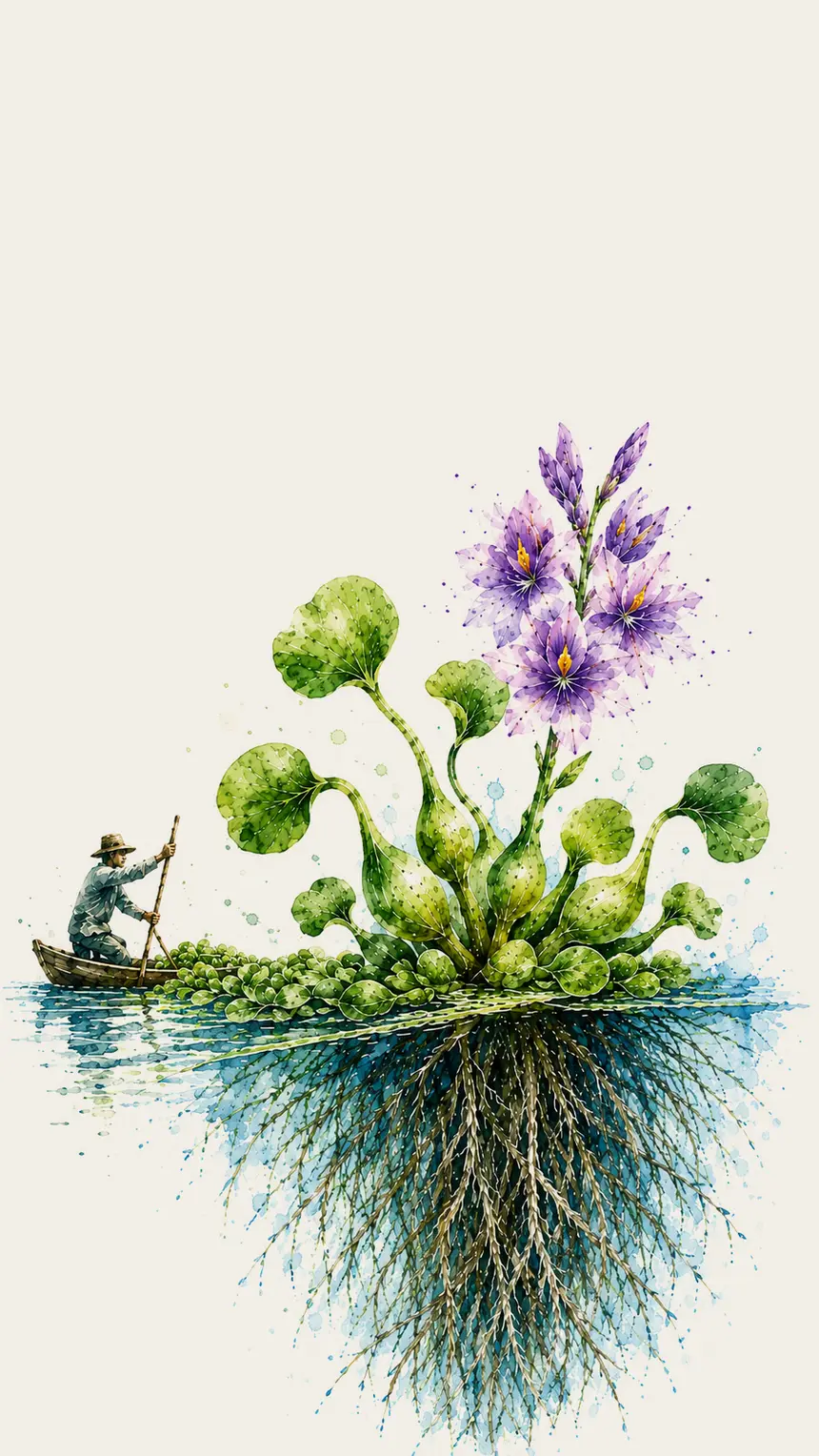
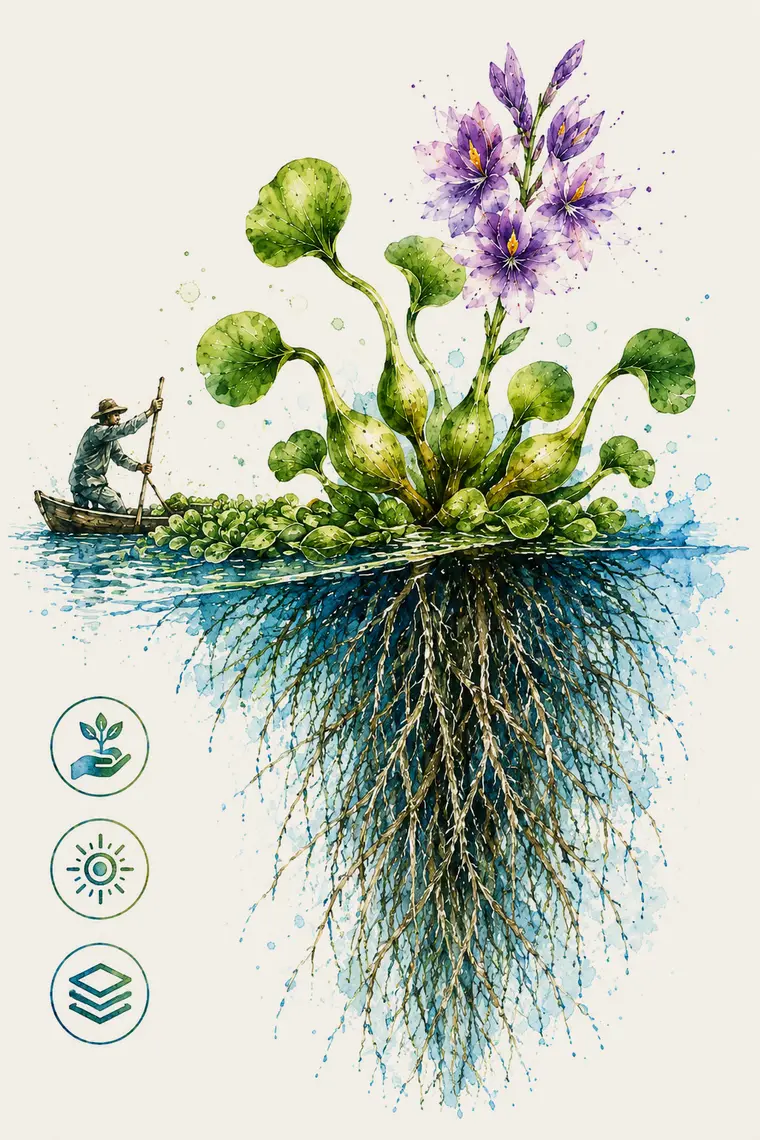
The month leaves are original watercolour studies of Eichhornia crassipes — the whole plant, the flower spike, the air-filled stalk, the root mass, the seed head. Painted in muted olive and sage, deep indigo and the plant's real lilac-violet bloom.
Not a single month shows a choked canal. A desk calendar is looked at every morning for a year; it should not induce guilt. The problem story lives on the story card and the base panel, where it can be read once and understood properly.
By December the reader has been taught, without being told, exactly why this plant is unstoppable.
Artwork status: the illustration direction shown across this page is final. The full set of twelve month leaves is in development and will be shown here once complete, alongside product photography from September 2026.
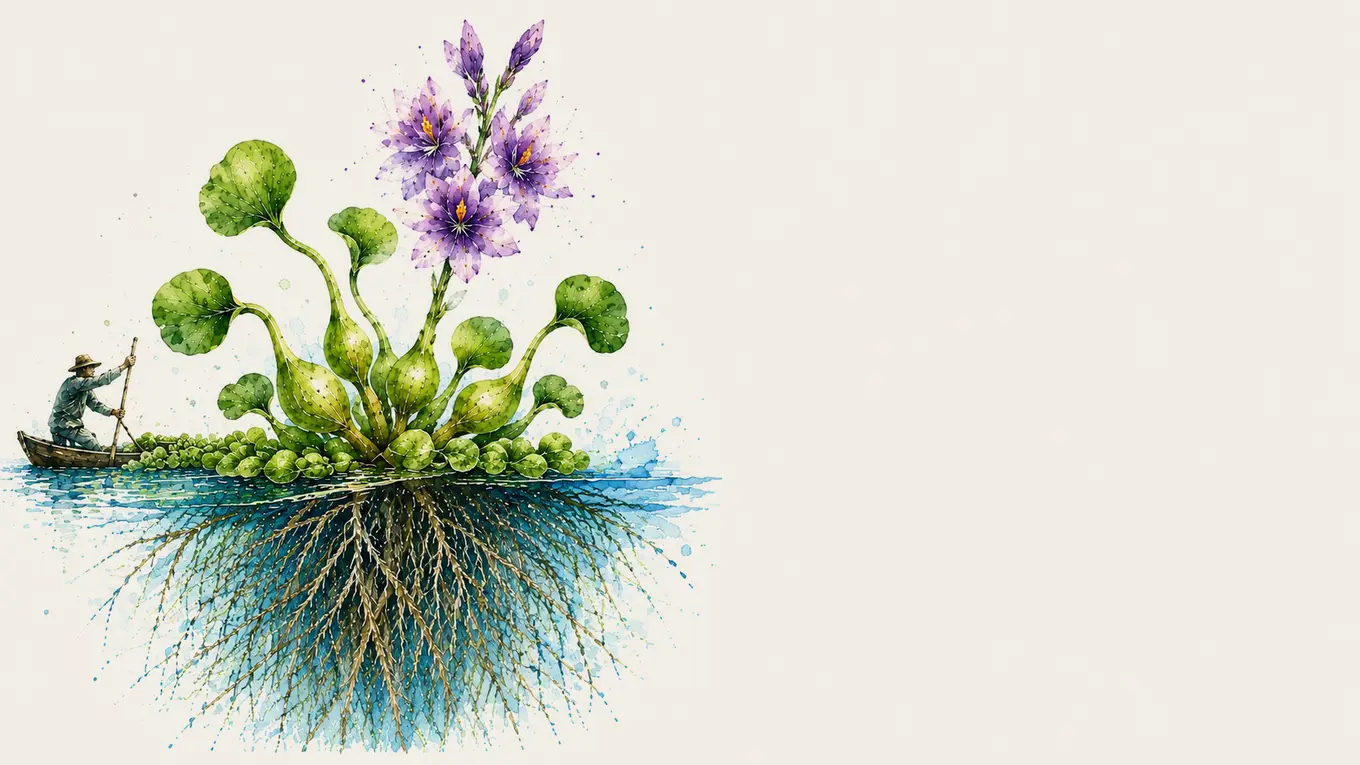
The 2027 desk calendar
Fourteen sheets. Twelve of them are the plant itself.
Printed by digital multicolour on handmade water hyacinth stock at roughly 245 gsm. The flecked sheet stays visible through the ink — that is the point of it.
- ×12 leavesMonth leaves — watercolour specimen studies with a one-line caption beneath each.
- ×1 coverDevanagari जलकुंभी with the locked English descriptor: paper from India's most invasive water plant.
- ×1 cardStory card — the problem, the four-stage process, and your calendar's own kilo figure.
- Base panelYour logo beside the impact line: 3 kg of water hyacinth. Out of the water, onto your desk.
No product photography yet — deliberately. Physical samples are expected from September 2026. Rather than show a render and call it a product, this page shows the material story and the illustration direction. Photographs replace this note as soon as samples are shot.
The sustainable corporate calendar question
A calendar is a dated object. So we made most of this one undated.
The awkward truth about eco-friendly calendars is that a calendar is designed to become worthless on 1 January. Material is only half the problem — the other half is how much of the object dies with the year.
On a Jalkumbhi calendar the base board, the cover and the packaging carry no year at all. Only the twelve month leaves are dated. Keep the base and next year's calendar is twelve printed sheets, not a whole new product.
That matters three ways. Your reorder cost falls. The waste falls with it. And it is honest to admit the third reason: an unsold run costs us a reprint of twelve sheets rather than a scrapped product, which is exactly why print-on-demand is possible at all. A sustainability decision that also protects the P&L is the kind that survives.
Stack that on the material and Jalkumbhi is doing two things at once — the sheets were made from a weed that had to be cleared anyway, and the rest of the object was never disposable to begin with.
The useful question is not “is this calendar eco-friendly?” It is “which parts of it are dated, and what were they made of before?”
- UndatedBase board, cover, sleeve and packaging. Reusable in 2028 and beyond.
- DatedTwelve month leaves only. Reprinted annually, at a fraction of the product cost.
- Removed3 kg of water hyacinth per B6 calendar, cleared from Indian waterways before printing.
- Not claimedCertification, carbon neutrality, trees saved, guaranteed anything.
Sizes, formats and indicative pricing
Pick the size. The size sets the impact.
The kilo figure is a function of paper area, not of the stand. A bigger calendar clears more water — which makes the size decision an impact decision, not only a budget one.
| Size | Trim | Paper in the product | Water hyacinth cleared | Indicative price |
|---|---|---|---|---|
| B7 portraitCompact desk / high volume | 88 × 125 mm | ≈ 38 g | ≈ 1.5 kg | ₹100 – ₹250 |
| B6The standard. Portrait or landscape. | 125 × 176 mm | ≈ 75 g | ≈ 3 kg | from ₹225 |
| B5Leadership and key-account gifting | 176 × 250 mm | ≈ 150 g | ≈ 6 kg | from ₹333 |
Indicative per-piece pricing, excluding GST and freight. Final pricing depends on quantity, stand format, branding and artwork. Reseller and volume pricing is quoted on request. Jalkumbhi is made to order — nothing is printed without a confirmed order.
Wooden easel
Warm, simple, the most familiar desk silhouette.
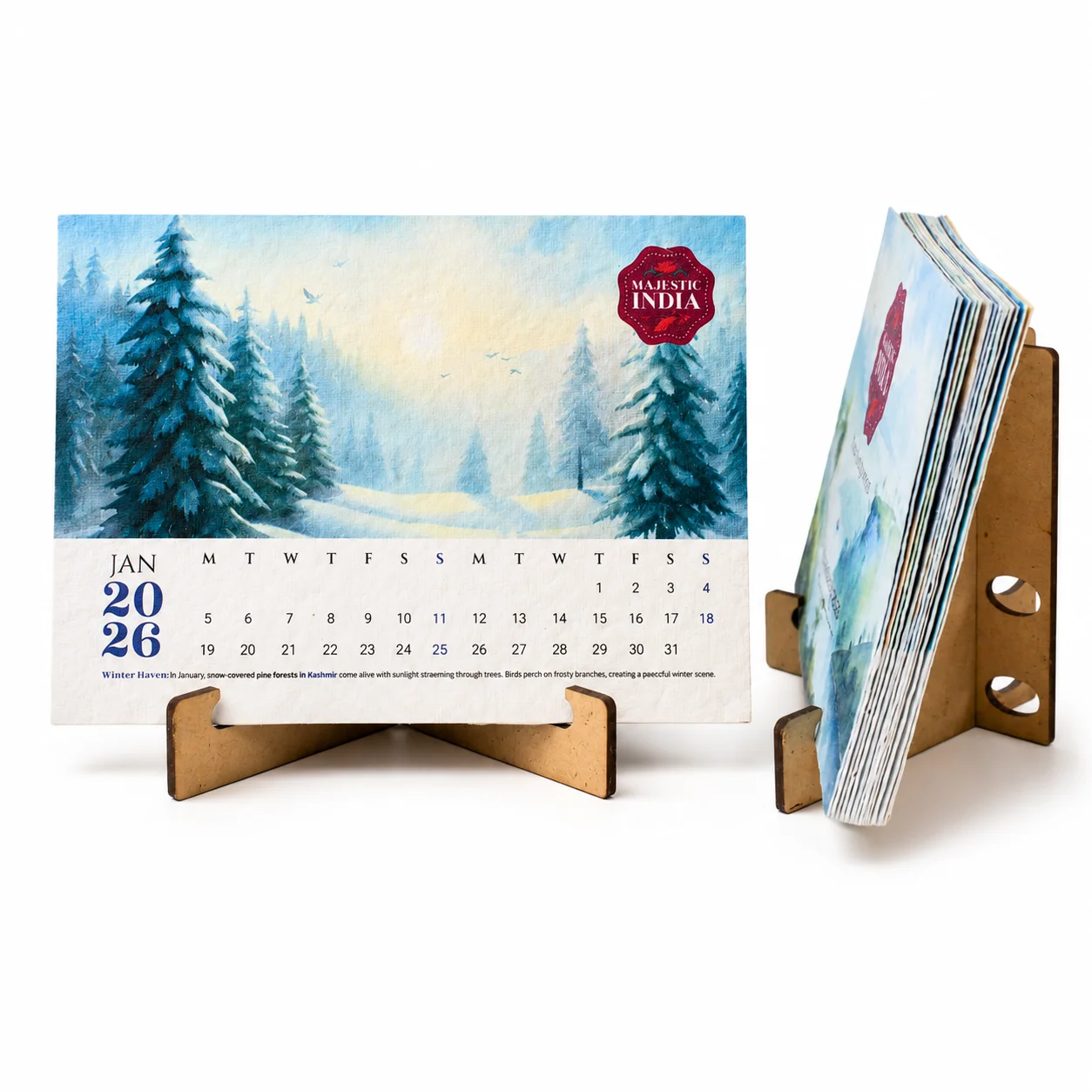
MDF flat-pack stand
Assembled by the recipient. Ships flat, lands cheaper.
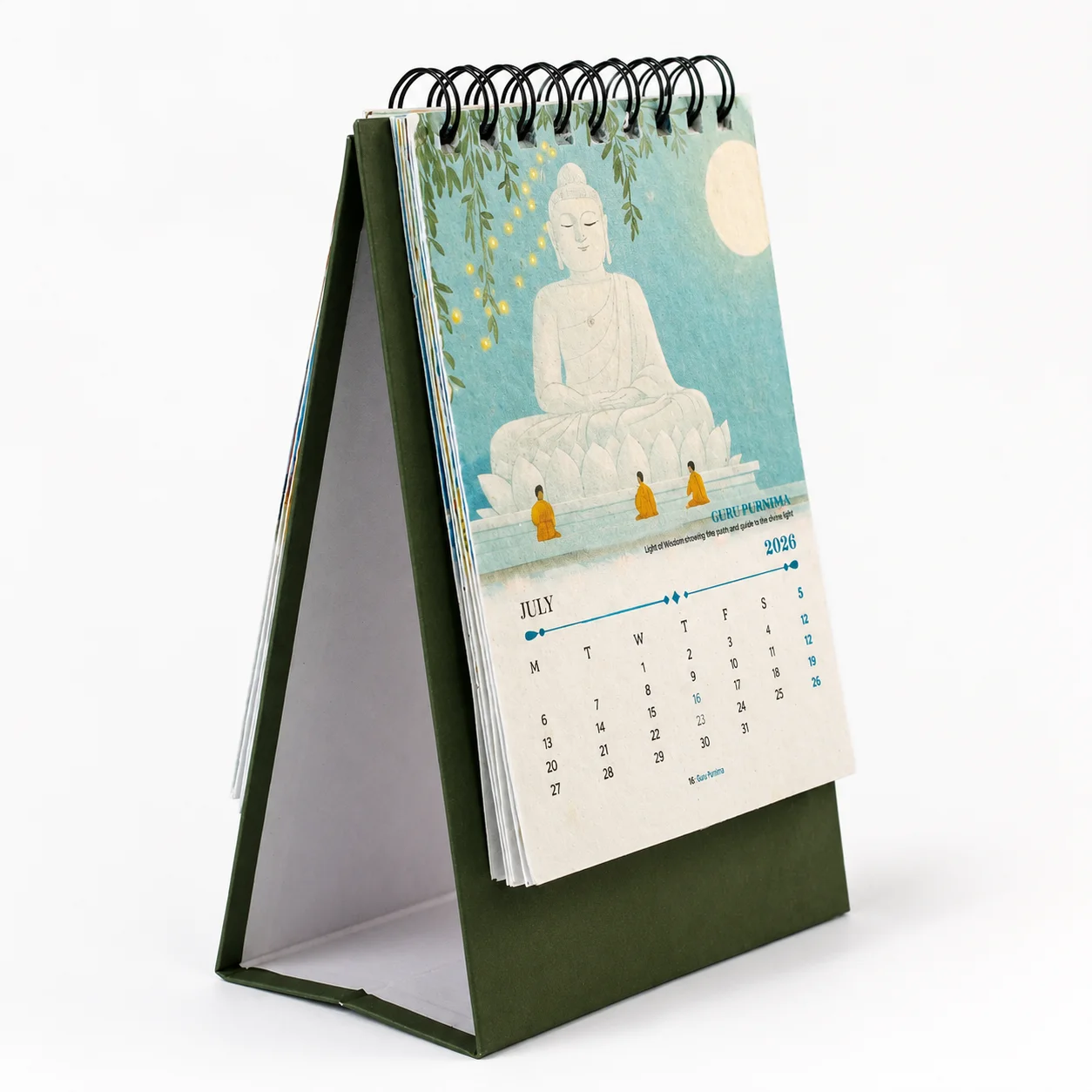
WireO bound
Clean upright flip. Best for a full-bleed plate.
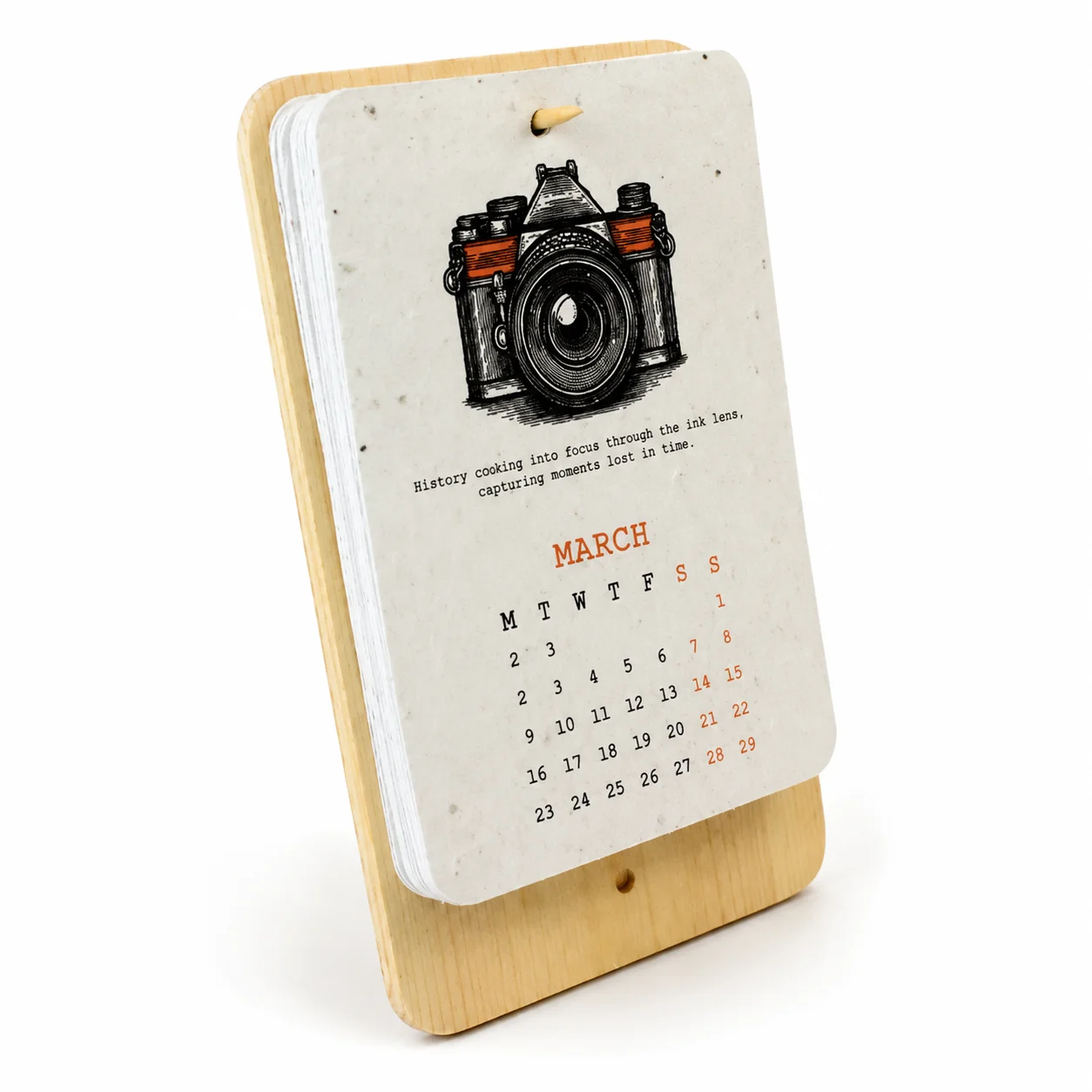
Wooden plate stand
The premium option, with a front hook and rear support.
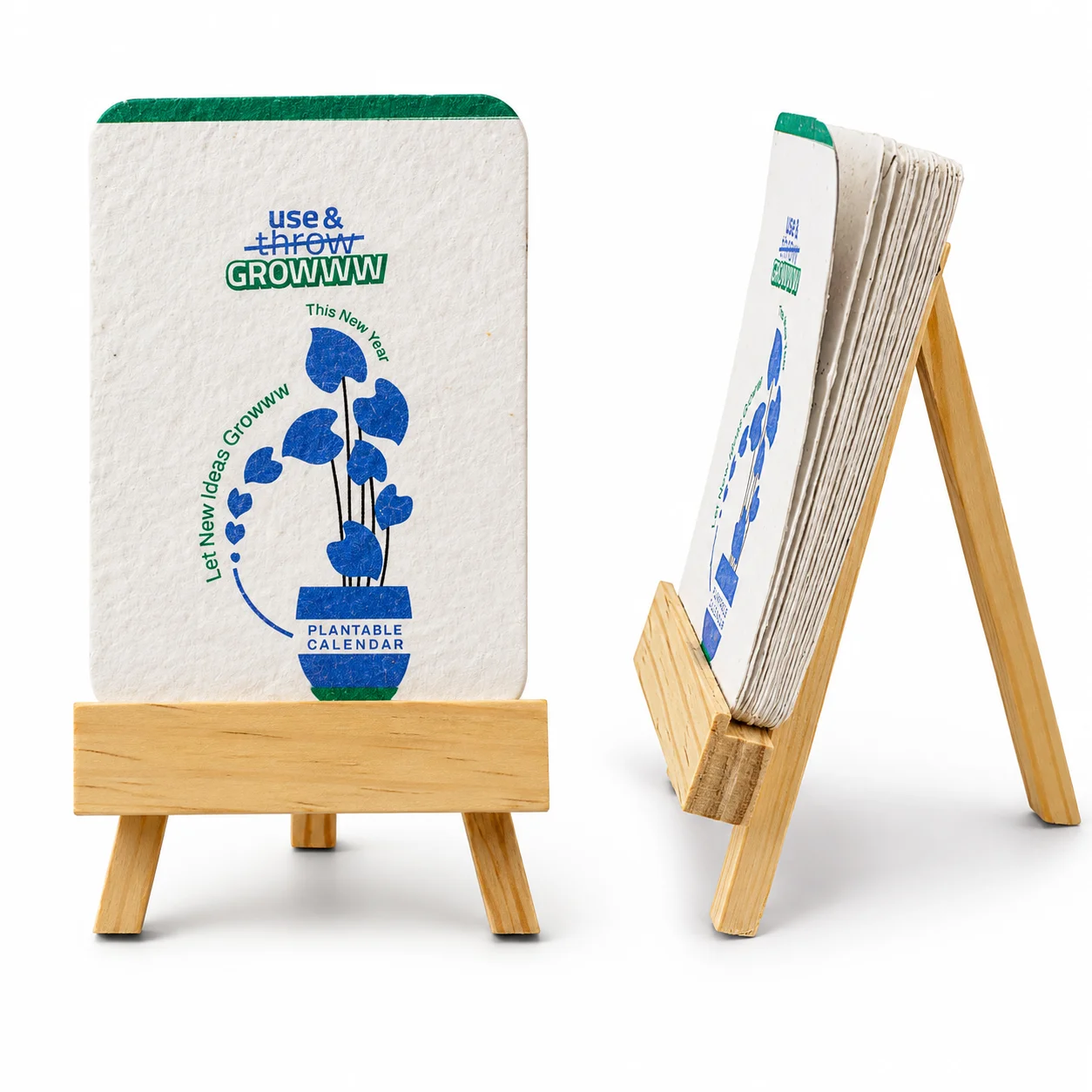
Stand photography shown is from bioQ's existing seed-paper calendar range. The same four stand formats carry the Jalkumbhi sheet — only the paper changes. Jalkumbhi product photography follows once samples are shot in September 2026.
What it is not
The honest limits, before you ask for them.
It is not a strength paper.
Handmade water hyacinth stock is textured and comparatively soft. It is right for calendar leaves, cards, covers and sleeves. It is not structural packaging, not a load-bearing board and not suited to wet or food-contact use.
Source water matters, so we control it.
Water hyacinth absorbs what is in the water it grows in — that is exactly why it is used for phytoremediation. We source from agricultural and municipal waterbodies, not from industrial outfall channels.
It is not cheaper than wood pulp.
Hand harvesting, sun-drying and hand sheet-forming cost more than a mill reel. Jalkumbhi is not a saving. It is a better material with a story that survives scrutiny.
Colour behaves differently on this stock.
The sheet is absorbent and uncoated, so colours print duller and darker than they appear on screen, and fine hairline detail fills in. Every artwork is proofed on real stock at final size before a run is committed. No white ink is used.
We hold one number, and only one.
No certification. No carbon-neutral claim. No trees saved. The single figure we publish is the weight of water hyacinth harvested from Indian waterways to produce the paper in your product — and we show the arithmetic that produces it.
The 2027 calendar window
Calendars are decided in autumn and regretted in January.
Jalkumbhi is print-on-demand: no speculative stock, no leftover boxes. That makes the order window real rather than a sales tactic.
Enquire and shortlist
Size, stand format, quantity and branding direction. Indicative costing issued against your numbers.
Samples in hand
Physical calendar and paper samples, so the stock can be seen and felt before anything is committed.
Artwork and order close
Logo placement, story-card co-branding, printed proof on real stock, then confirmed order.
Production and dispatch
Printed, assembled, packed and shipped in time for the 2027 desk year.
Questions procurement actually asks
Answered plainly.
If the answer to a sustainability question is uncomfortable, it is usually the one worth publishing.
What is the most sustainable corporate calendar?
It depends which kind of waste you are trying to avoid, and the material is only half the answer. A calendar is a dated object — most of it becomes worthless on 1 January, and that is the bigger problem.
Least wasteful by design: a cork block calendar, because nothing on it is dated. Best transformation: plantable seed paper, where the finished month becomes a plant. Best quantified claim: water hyacinth — a B6 Jalkumbhi calendar clears about 3 kg of invasive weed from Indian waterways, and its base, cover and packaging are year-agnostic so only the twelve leaves are dated. Full comparison of all four materials.
Is this an eco-friendly corporate calendar, and what does that actually mean here?
It means one specific, checkable thing: the paper is 100% water hyacinth harvested from Indian waterways, and we publish the 40:1 ratio used to calculate the kilos cleared per calendar, along with the losses that produce it.
It does not mean certified, carbon neutral or trees saved. We make none of those claims. If a supplier uses “eco-friendly” as an adjective with no number behind it, the useful next question is what the number is.
How does this compare to a plantable seed paper calendar?
They make opposite claims. Seed paper adds a plant after use — which depends on the recipient actually planting it. Water hyacinth removes a plant before the paper exists — which depends on nobody. Seed paper is the stronger emotional story; water hyacinth is the stronger procurement story. bioQ makes both, and neither is universally better. See plantable paper.
What is water hyacinth paper?
Handmade paper made from the stalks of Eichhornia crassipes, an invasive floating plant that clogs Indian waterways. The plant is harvested by hand, stripped, sun-dried, cooked, beaten to pulp and lifted into sheets. Jalkumbhi paper is 100% water hyacinth with no fibre blend.
How much water hyacinth does one calendar clear?
Approximately 1.5 kg for a B7 calendar, 3 kg for B6 and 6 kg for B5. Each figure is the paper weight in that product multiplied by the published 40:1 harvest-to-paper ratio.
Why 40:1, and can you defend it?
Two losses compound. Fresh water hyacinth is roughly 90–95% water, so sun-drying collapses it to 5–10% of harvest weight. Only stalks carry usable fibre, and pulping yield from that dry mass runs 30–40%. That gives a defensible band of 25:1 to 67:1. We publish 40:1 — mid-band, not the flattering end. Because the sheet is 100% water hyacinth, there are no blend fractions to argue over.
Is the calendar plantable, like seed paper?
No. Water hyacinth paper carries no seeds and is not planted after use — it is a different product from bioQ's plantable seed paper. Seed paper adds a plant after use. Water hyacinth paper removes one before it is made. If you want the planting ritual instead, see plantable paper.
Can our logo and brand colours be printed on it?
Yes. We print by digital multicolour, so there are no registration limits. The stock is absorbent and flecked, so colours print duller and darker than on screen, tints below about 40% get eaten by the speckle, hairline detail fills in, and white ink is not used — the natural sheet is the light source. Every artwork is proofed on real stock at final size before a run is committed.
What does it cost?
Indicative per-piece pricing is from ₹225 for B6 and from ₹333 for B5, with B7 formats in the ₹100–₹250 band, excluding GST and freight. Final pricing depends on quantity, stand format and branding. Reseller and volume pricing is quoted on request.
Is it certified, or carbon neutral?
No, and we do not claim it. There is no certification behind this paper, no carbon-neutral claim and no trees-saved figure. We publish one number — the weight of water hyacinth harvested from Indian waterways to make the paper in your product — and we show the arithmetic behind it so you can check it yourself.
Where does the water hyacinth come from?
From agricultural and municipal waterbodies in India where the plant is already a clearance problem. Because water hyacinth absorbs what is in the water it grows in, we do not source from industrial outfall channels.
Can we get it in a kit, with other bioQ products?
Yes. The calendar sits naturally in a New Year desk kit alongside bioQ's plantable stationery, cork desk pieces and Forever Forest products. Tell us the kit budget and we will build the combination around it.
2027 enquiries are open
Tell us the audience, the quantity and the date.
We will come back with sizes, stand options, indicative costing and — once September samples are in — a physical sample you can put on a desk and argue about.
- Product
- Jalkumbhi 2027 desk calendar · B7, B6, B5 · 14 sheets · 100% water hyacinth
- Impact per piece
- 1.5 kg · 3 kg · 6 kg of water hyacinth cleared from Indian waterways
- Production
- Made to order. No speculative stock. Samples from September 2026.
- Also in this line
- A 5″ × 7″ water hyacinth notebook, with visible fibre on the cover.