

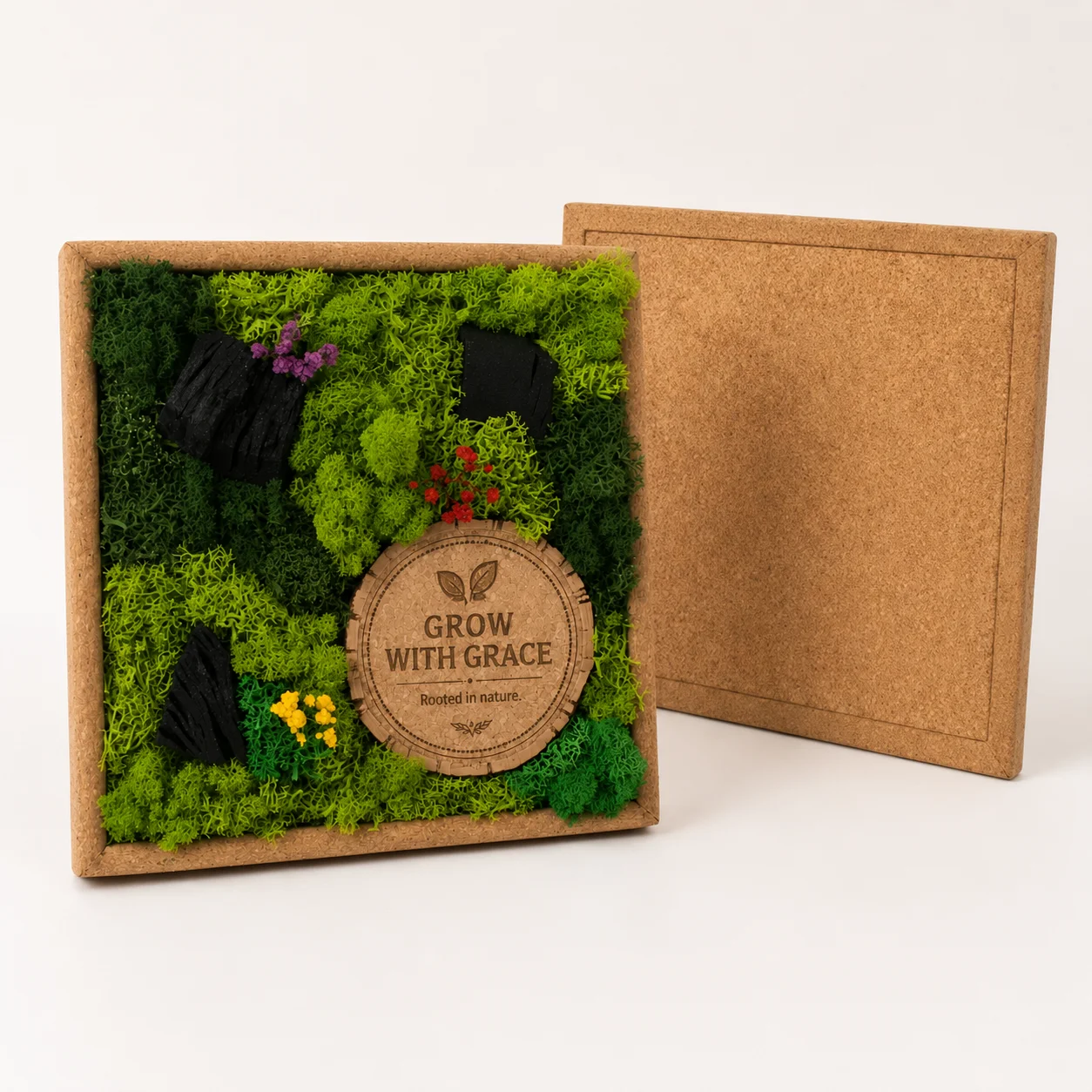
Preserved botanical gifts bring real natural form and texture into an indoor space without asking the recipient to water, trim or grow a living plant.
What are preserved botanical gifts?
Preserved botanical gifts are made with real plant material that has been treated to retain its form, colour and texture for indoor display. The botanicals are no longer living, so they do not grow and do not need watering or routine plant care.
They are different from artificial plants, which are manufactured from non-botanical materials, and from ordinary dried flowers, which typically become more brittle as their natural moisture is removed.
At bioQ, preserved moss, flowers, foliage, bark and other natural textures are arranged by hand across framed art, desk pieces, enclosed displays, awards, organisers and curated gifts.
Are preserved botanicals real plants?
They begin as real botanicals, but a preserved botanical is not a living plant after treatment.
That distinction matters because it determines both care and communication.
| Type | What it is | Routine care | What not to imply |
|---|---|---|---|
| Live plant | A living, growing plant | Water, light and species-specific care | That it will thrive in every office setting |
| Preserved botanical | Real plant material treated for indoor display | No watering; protection from sun, humidity, dust and handling | That it is still alive, growing or purifying air |
| Dried botanical | Real plant material dried by removing moisture | Dry handling; often more brittle | That it has the softness of a preserved piece |
| Artificial plant | A manufactured imitation | Surface cleaning | That it is real botanical material |
The clearest phrase is “real preserved botanicals”. It communicates the material truth without making the product sound like a live plant.
How does bioQ preserve its botanical material?
bioQ uses a controlled, multi-step process designed to retain natural form, colour and texture.
1. Select
Botanical material is selected at a visually suitable stage, when its form, texture and colour can contribute to the final composition.
2. Preserve
Under controlled conditions, a bio-based preservation blend gradually replaces the plant’s natural moisture.
3. Stabilise the appearance
Plant-based stabilisers are used to help retain natural tones and keep relevant textures soft and detailed.
4. Rest and arrange
Once the preserved material is ready, individual pieces are selected and arranged by hand. Variations in shape, shade and texture are part of the material rather than manufacturing defects.
The process is designed for indoor display. It does not turn the botanicals into living plants, and it should not be described as an air-purifying or carbon-absorbing process.
Why do preserved botanicals work well for gifting?
They occupy a useful space between a live plant and a conventional decorative object.
They bring real natural texture indoors
The recipient sees actual preserved moss, foliage or flowers rather than a printed nature motif. This gives the gift a tactile, visual material story.
They do not require watering
This suits desks, reception areas, meeting rooms and recipients who may not be able to maintain a live plant.
They can remain visible for years
A well-placed piece can continue to carry a recognition, campaign or brand message long after the gifting moment.
Every composition is slightly different
Because the botanical material is real and pieces are hand-arranged, natural variation gives each gift some individuality.
They support several levels of gifting
The format can range from a compact desk object to a substantial framed work or executive display. That allows the same material language to serve employee gifts, awards, leadership recognition and premium client programmes.
What preserved botanical gift formats does bioQ make?
The current bioQ range shows that preserved botanicals can become a complete design family rather than a single product type.
Frames and botanical art
These make the preserved material visually dominant and work well for walls, desks, receptions and recognition.
Examples in the bioQ range include Forest Chronicles frames, Forest Aqua compositions and compact Forest Frame formats. Some combine preserved botanicals with cork, wood, resin water art or a protective cover.
Enclosed desk displays
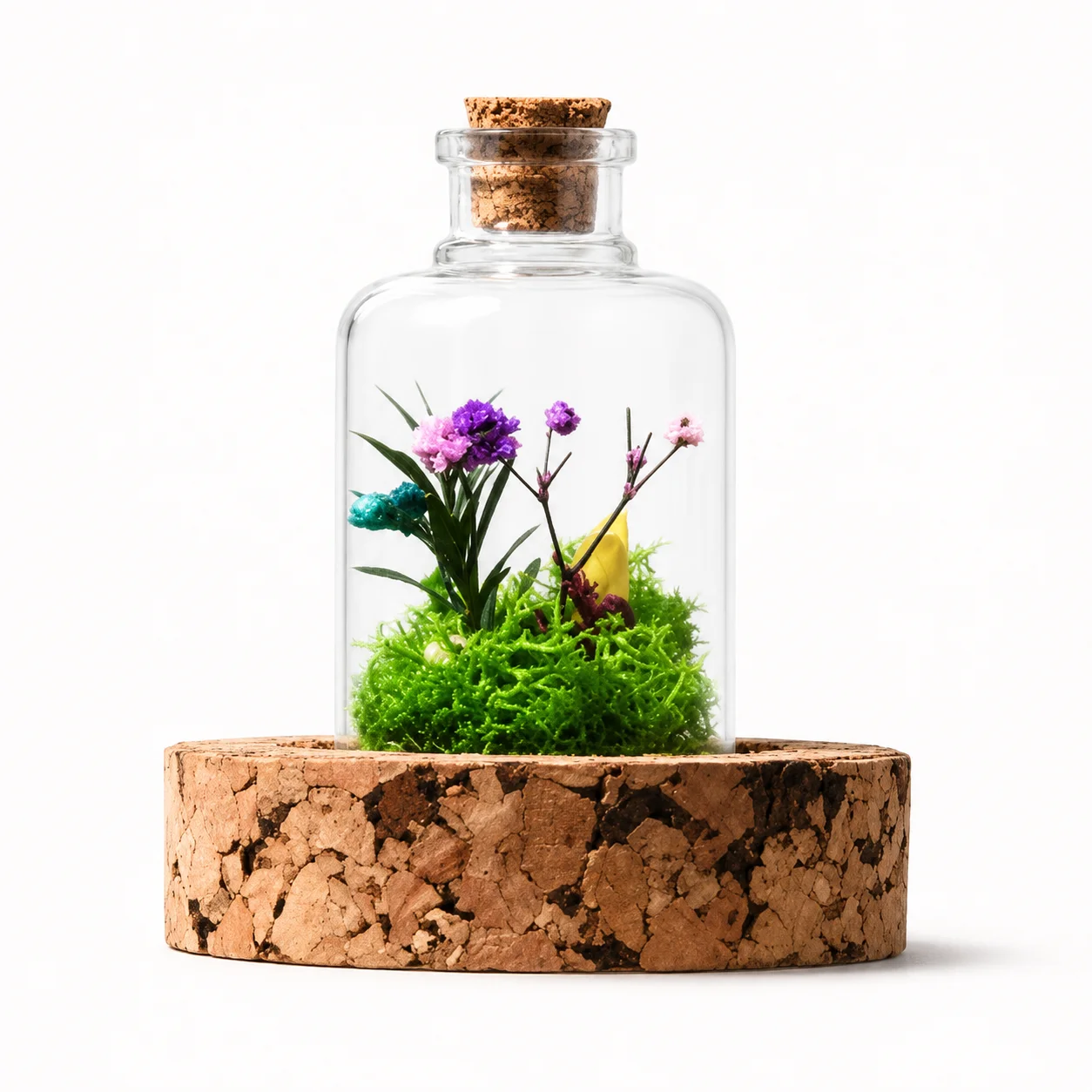
Glass or acrylic enclosures reduce direct handling and dust exposure. Towers, domes, terrariums and compact enclosed pieces suit workstations, shelves and reception desks.
Examples include Forest Tower, Garden Dreams Dome and Forest Terrarium formats.
Open desk pieces
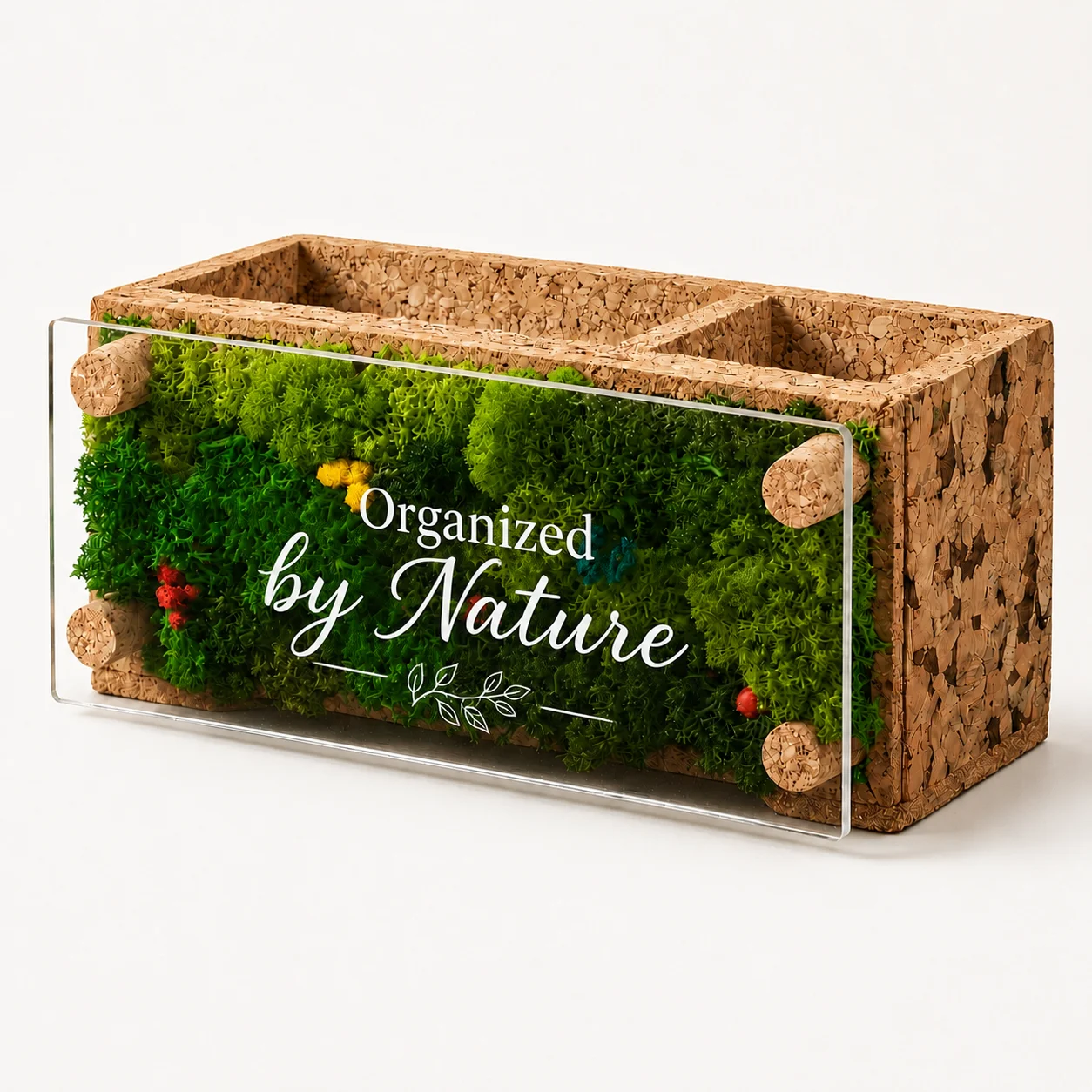
Open bowls, tiles, organisers and stands bring the botanical material closer to the recipient. They need calmer placement and occasional gentle dust care.
Awards and recognition pieces
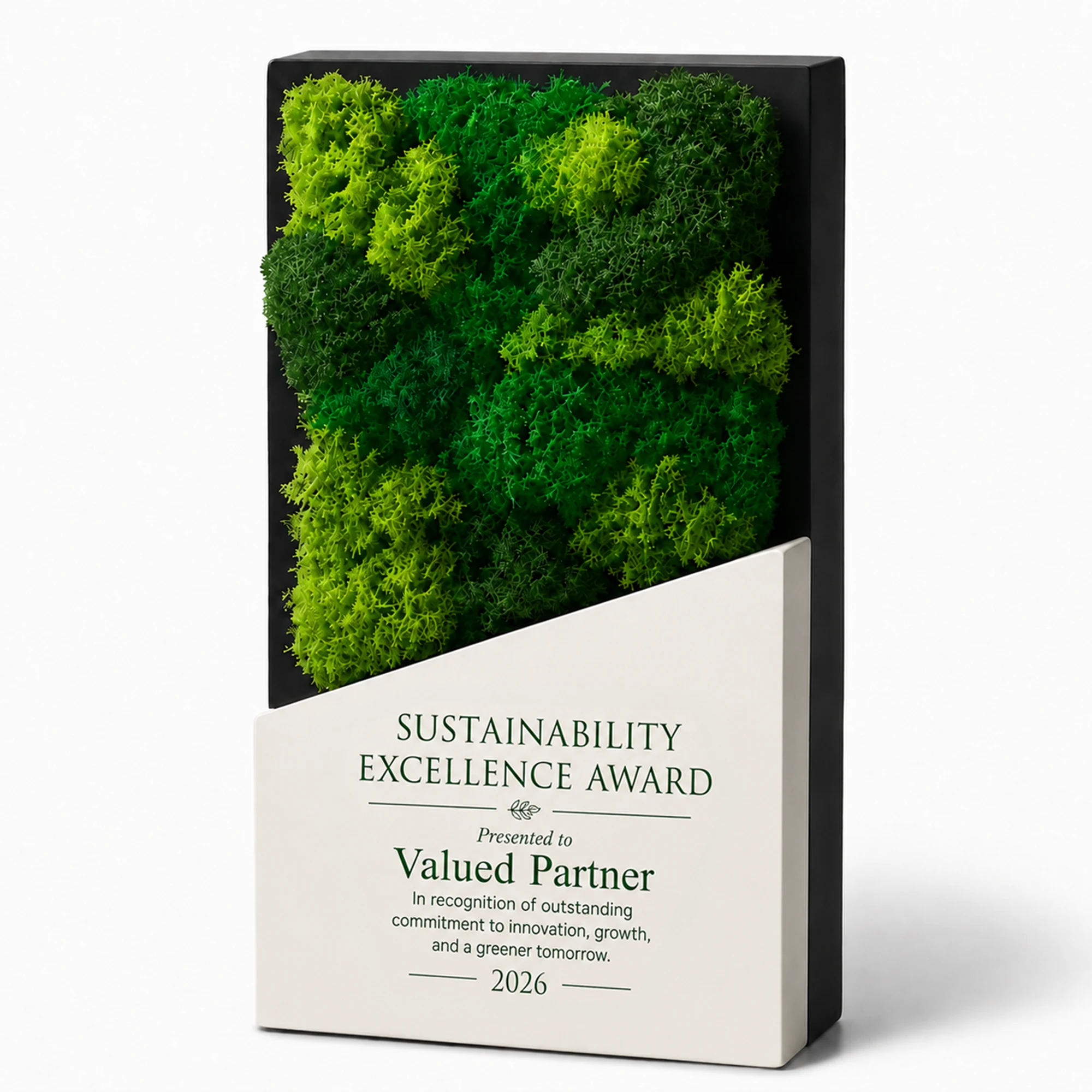
Preserved botanicals can soften the conventional plaque or trophy format. The product may combine botanical material with MDF, acrylic, wood, metal or printed elements, so claims should identify those components accurately.
Executive and premium gifts
Larger framed pieces, desk stations and curated sets can combine preserved botanicals with cork stationery, bamboo writing tools, drinkware or other useful items.
Cultural and festive formats
Selected bioQ pieces combine preserved botanicals with devotional objects, candles, incense, festive desk elements or occasion-led packaging. The botanical story should remain clear even when the overall gift has several materials.
Should a buyer choose an open or enclosed piece?
Choose according to the recipient’s space, the desired visual experience and the amount of protection the piece needs.
| Consideration | Open preserved piece | Enclosed preserved piece |
|---|---|---|
| Visual character | More immediate and tactile | More protected and display-like |
| Dust exposure | Botanicals may collect dust over time | Cover shields the botanicals from most dust |
| Handling | Needs a calm location and gentle treatment | Cover reduces direct handling |
| Cleaning | Gentle air or a very soft dry brush | Soft dry cloth on the outside of the cover |
| Typical appearance guidance | 3+ years with suitable indoor care | 5+ years with the enclosure closed and suitable indoor care |
| Good settings | Private desks, shelves and calm interiors | Shared offices, receptions, high-traffic desks and gifting where protection matters |
These time periods are appearance guidance, not expiry dates. After the guidance period, the botanical material does not suddenly disappear or dry out completely. Its colour, softness and visual finish may gradually change, and it may not look as fresh as it did when new.
How should an open preserved botanical piece be cared for?
Open pieces need no watering or trimming, but they benefit from thoughtful placement.
Do
- Keep the piece indoors at normal room temperature.
- Place it on a stable desk or shelf away from edges.
- Keep it dry and away from very humid areas.
- Keep it away from strong direct sunlight.
- Avoid strong fan or air-conditioning drafts.
- If dust settles, use gentle air or a very soft, dry brush.
- Let the botanical textures remain largely untouched.
Do not
- Spray water or wipe the botanicals with a wet cloth.
- Squeeze, scratch, pluck or repeatedly handle the material.
- Place it where it will be bumped or moved often.
- Use strong compressed air at close range.
- Keep it outdoors, in a bathroom or in another persistently humid area.
Light touch is generally less risky than repeated handling, but the fine structure can break. The best care is to look rather than pluck or press.
How should an enclosed preserved botanical piece be cared for?
The enclosure is part of the product’s protection. It helps reduce dust, humidity exposure and direct handling.
Do
- Keep the piece indoors, away from direct sunlight.
- Place it on a stable surface.
- Keep the transparent cover closed.
- Wipe the outside gently with a soft, dry cloth.
- Move the piece carefully and keep it upright where the design requires.
Do not
- Open the enclosure to touch or rearrange the botanicals.
- Press, shake or tilt the piece unnecessarily.
- Spray cleaning liquid directly onto openings or joins.
- Place it in a very humid area or under strong sunlight.
An enclosed piece should remain enclosed. Opening it removes the protection that supports its longer appearance life.
Does “no watering” mean “zero maintenance”?
It means the gift needs no routine plant care: no watering, trimming, fertilising or sunlight schedule.
An open piece may still need occasional gentle dust removal. An enclosed piece may need its outer cover dusted with a dry cloth. “No watering” or “no routine plant care” is therefore clearer than suggesting that the object can be placed anywhere and ignored indefinitely.
How long do preserved botanical gifts last?
bioQ’s practical guidance is:
- Open preserved pieces: 3+ years in normal indoor conditions with suitable placement and gentle care.
- Enclosed preserved pieces: 5+ years in normal indoor conditions when the cover remains closed and the piece is protected from sun, humidity and rough handling.
The exact appearance life varies with the botanical material, format, exposure and care. These are not living products and should not be assessed by growth. Over time, natural colour and texture may change while the arrangement remains present.
What should companies say about preserved botanical gifts?
Use language about the material, display experience and care.
Clear statements
- Made with real preserved botanicals.
- Hand-arranged with natural variation.
- Designed for indoor display.
- Needs no watering or trimming.
- Open pieces can remain attractive for 3+ years with suitable care.
- Enclosed pieces can remain attractive for 5+ years when kept closed and cared for as instructed.
Statements that need product-specific confirmation
- The exact frame, base, cover, resin, wood, cork or recycled-polymer material.
- The proportion of preserved botanical material.
- Recycled content.
- Custom branding method.
- Product dimensions and expected appearance guidance.
Avoid
- Live plant.
- Air-purifying.
- Oxygen-producing.
- Carbon-absorbing.
- Carbon-negative.
- Fully biodegradable.
- 100% natural when the complete product includes frames, acrylic, resin, MDF, adhesives or other materials.
- Guaranteed to look unchanged for a fixed number of years.
Preserved botanicals are strongest as an emotional and design-led material story. They do not need a false live-plant benefit added to them.
What other materials may be present?
A preserved botanical gift is usually a designed object, not loose botanical material.
Depending on the product, it may include:
- Cork or cork-faced MDF.
- Wood or bamboo.
- MDF frames or bases.
- Glass or acrylic covers.
- Resin water-art elements.
- Recycled-polymer bases.
- Metal fittings or idols.
- Marble, ceramic or stone.
- Printed paper, cards or packaging.
This is why the claim should name the preserved botanical element rather than describe the entire product as natural, plastic-free or biodegradable.
Recycled paper generally plays a supporting role in bioQ’s wider range, especially in stationery, writing tools, message cards and packaging. Cork can be a visible structural or tactile material. Preserved botanicals remain the central visual and emotional element in a Forever Forest piece.
How should a company choose the right preserved botanical gift?
Ask five questions:
1. Where will it live?
A private desk may suit a compact open piece. A reception or shared workspace may benefit from an enclosure.
2. How premium should the moment feel?
Small botanical keepsakes work for broader employee programmes. Framed art, executive desk stations and larger enclosed pieces suit recognition and leadership gifting.
3. Will the recipient travel with it?
Fragile, open or large pieces need appropriate transport packaging. A compact enclosed format may be easier for distributed gifting.
4. What should be branded?
Branding can sit on a frame, plaque, base, sleeve or accompanying message card. It should not cover the botanical composition or require unnecessary material additions.
5. What story should accompany it?
The recipient needs to know that the botanicals are real, preserved, indoor-only and do not need watering. Include the correct open or enclosed care guidance.
Suggested recipient care card
For an open piece
Your gift is made with real preserved botanicals. Keep it indoors, dry and away from direct sunlight and strong drafts. Do not water, press or pluck the material. If dust settles, use gentle air or a very soft, dry brush.
For an enclosed piece
Your gift is made with real preserved botanicals protected by a clear enclosure. Keep it indoors and away from direct sunlight. Leave the cover closed and dust only the outer surface with a soft, dry cloth.
Frequently asked questions
Are preserved botanicals alive?
No. They begin as real botanical material but are no longer living after preservation. They do not grow or need watering.
Can preserved botanicals purify the air?
No such claim should be made. Preserved botanicals are valued for real natural form, colour, texture and indoor display, not live-plant functions.
Can I touch them?
Light touch is less risky than repeated handling, but fine moss, flowers and foliage can break. Open pieces are best enjoyed without pinching, pulling or pressing.
What happens if dust settles?
For open pieces, use gentle air or a very soft, dry brush. For enclosed pieces, keep the cover closed and wipe only the outside with a soft, dry cloth.
Can I put the gift near a window?
Keep it away from strong direct sunlight. Soft indoor light is more suitable.
Does it need to be watered occasionally?
No. Water can damage preserved botanical material. Do not mist, spray or wipe it with a wet cloth.
Will it look exactly the same forever?
No natural material remains visually unchanged forever. With suitable indoor care, bioQ guides buyers to expect 3+ years for open pieces and 5+ years for enclosed pieces. Colour and texture may gradually change after that.
Bring a piece of forest into the brief
Tell bioQ where the gift will be displayed, who will receive it, the quantity, budget, delivery date and branding requirement. We can recommend an open or enclosed format and provide the correct material and care communication.
Explore Forever Forest gifting
Share the audience, quantity, occasion, budget, delivery date and branding requirement. bioQ can suggest a claim-safe direction and explain the real material story behind it.
